Things to do in Rome
-
A
Chiesa del Domine Quo Vadis?
This pint-sized church marks the spot where St Peter, fleeing Rome, met a vision of Jesus going the other way. When Peter asked: ‘Domine, quo vadis?’ (‘Lord, where are you going?’), Jesus replied, ‘Venio Roman iterum crucifigi’ (‘I am coming to Rome to be crucified again’). Reluctantly deciding to join him, Peter tramped back into town where he was arrested and executed. In the aisle are copies of Christ’s footprints; the originals are in the Basilica di San Sebastiano.
reviewed
-
B
Bocca della Verità
A round piece of marble once used as an ancient manhole cover, the Bocca della Verità (Mouth of Truth) is one of Rome's great curiosities. Legend holds that if you put your hand in the carved mouth and tell a lie, it will bite your hand off.
The mouth lives in the portico of the beautiful, medieval Chiesa di Santa Maria in Cosmedin. Originally built in the 8th century, the church was given a major revamp in the 12th century, when the seven-storey bell tower and portico were added and the floor was decorated with Cosmati inlaid marble. Opposite the church are two small Roman temples: the round Tempio di Ercole Vincitore and the Tempio di Portunus. Just off the piazza, the
reviewed
-
C
Villa Borghese
Locals, lovers, tourists, joggers – no one can help heeding the call of this ravishing park just north of the historic centre. Originally the grounds of Cardinal Scipione Borghese’s 17th-century residence, the park has various museums and galleries, as well as other attractions such as the 18th-century Giardino del Lago and Piazza di Siena, an amphitheatre used for Rome’s top equestrian event in May. Near the Piazzale San Paolo del Brasile entrance, the Cinema dei Piccoli is the world’s smallest cinema.
Bike hire is available at various points, including Via delle Belle Arti, for about €5/15 per hour/day.
reviewed
-
D
Trastevere
Although its traditionally proletarian nature is changing as the crumbling palazzi become gentrified, a stroll among the labyrinthine alleys of Trastevere still reaps small gems of a bygone past. Washing strung out from the apartments in best Mama-leone tradition has everyone sighing and reaching for the Kodaks.
The lovely Piazza Santa Maria in Trastevere is the area's heart. It's a true Roman square - by day peopled by mothers with strollers, chatting locals and guidebook-toting tourists, by night with artisans selling their craft work, young Romans looking for a good time, and the odd homeless person looking for a bed. The streets east of the piazza is where you'll find…
reviewed
-
E
Teatro dell'Opera di Roma
After seeing the functional and Fascist-era exterior, the interior of Rome's premier opera house – all plush red and gilt – is a stunning surprise. This theatre has an impressive history: it premiered Puccini's Tosca, and Maria Callas sang here. Built in 1880, it was given a Fascist makeover in the 1920s. Contemporary productions don't always match the splendour of the setting, but you may get lucky. Tickets for the ballet cost anywhere between €12 and €80; for the opera you'll be forking out between €23 and €150.
reviewed
-
F
Chiesa di Santa Maria del Popolo
Next to the Porta del Popolo is one of Rome's earliest, richest Renaissance churches. The first chapel was built here in 1099 to exorcise the ghost of Nero, who was buried on this spot and whose ghost was said to haunt the area. It was overhauled in 1462, after which Pinturicchio painted his beautiful frescoes. In Raphael's Cappella Chigi (mostly completed by Bernini some 100 years later) you'll find a famous mosaic of a kneeling skeleton. Adding some fierce, exquisitely rendered drama to the Cappella Cerasi, to the left of the altar are two Caravaggio masterpieces: the Conversion of St Paul and the Crucifixion of St Peter (both 1600–01).
reviewed
-
G
Museo e Galleria Borghese
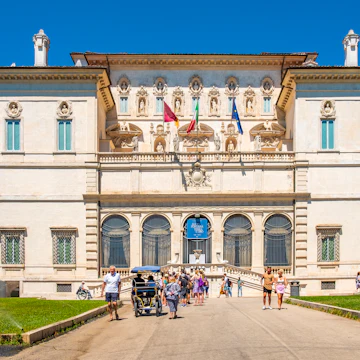
If you only have time (or inclination) for one art gallery in Rome, make it this one. Not only is it exquisite, but it provides the perfect introduction to Renaissance and baroque art without being overwhelming. To limit numbers, visitors are admitted at two-hourly intervals, so you'll need to call to pre-book, and enter at an allotted entry time – but trust us, it's worth it.
The collection, which includes works by Caravaggio, Bernini, Botticelli, Rubens, Raphael and Titian, was formed by Cardinal Scipione Borghese (1579–1633), the most knowledgeable and ruthless art collector of his day. It's housed in the Casino Borghese, whose neoclassical look is the result of a…
reviewed
-
H
Chiesa di Sant’Agostino
This early Renaissance church is a favourite of soon-to-be mums, who pop in to pay their respects to Jacopo Sansovino’s sculpture of the Virgin Mary, the Madonna del Parto (1521). The Madonna also features in Caravaggio’s Madonna dei Pellegrini (Madonna of the Pilgrims), which caused uproar when it was unveiled in 1604, due to its depiction of Mary as barefoot and her two devoted pilgrims as filthy beggars. Painting almost a century before, Raphael provoked no such scandal with his fresco of Isaiah, visible on the third pilaster on the left in the nave.
reviewed
-
I
Chiesa di San Carlo alle Quattro Fontane
It might not look it, with its filthy facade and unappealing location, but this tiny church is a masterpiece of Roman baroque. It was Borromini’s first church and bears all the hallmarks of his genius. The elegant curves of the facade, the play of convex and concave surfaces, the dome illuminated by hidden windows, all combine to transform a minuscule space into a light, airy interior.
The church, completed in 1641, stands at the road intersection known as the Quattro Fontane, after the late-16th-century fountains on its four corners, representing Fidelity, Strength and the Rivers Arno and Tiber.
reviewed
-
J
Museo Carlo Bilotti
The art collection of billionaire cosmetics magnate Carlo Bilotti is stylishly housed in the Orangery of Villa Borghese. It’s a small collection (only 22 pieces), but it’s interesting and well presented with explanatory panels in English and Italian. Paintings range from a Warhol portrait of Bilotti’s wife and daughter to 18 works by Giorgio de Chirico (1888–1978), one of Italy’s most important 20th-century artists.
reviewed
Advertisement
-
K
Hostaria Costanza
This is old-school Roman dining at its best. In the basement of Pompey's Theatre, Costanza serves up simple and wonderfully cooked food such as a creamy riso con fiori di zucca (risotto with courgette flowers), perfect ravioli di carciofi (ravioli with artichokes) and a simply delicious filetto di manzo al barolo (fillet of beef with barolo wine sauce). Bookings essential.
The waiters are friendly, the house wine is quaffable and the prices are remarkably reasonable.
reviewed
-
L
Basilica di San Clemente
This fascinating basilica provides a vivid glimpse into Rome's multilayered past: a 12th-century basilica built over a 4th-century church, which stands over a 2nd-century pagan temple and 1st-century Roman house. Beneath everything are foundations dating from the Roman Republic.
The medieval church features a marvellous 12th-century apse mosaic depicting the Trionfo della Croce (Triumph of the Cross) and some wonderful Renaissance frescoes in the Chapel of St Catherine, to the left of the entrance. Steps lead down to the 4th-century basilica inferiore, mostly destroyed by Norman invaders in 1084, but with some faded 11th-century frescoes illustrating the life of San…
reviewed
-
M
Chiesa di Sant’Andrea al Quirinale
It’s said that in his old age Bernini liked to come and enjoy the peace of this late-17th-century church, regarded by many as one of his greatest. Faced with severe space limitations, he managed to produce a sense of grandeur by designing an elliptical floor plan with a series of chapels opening onto the central area. The opulent interior, decorated with polychrome marble, stucco and gilding, was a favourite of Pope Alexander VII, who used it while in residence at the Palazzo del Quirinale.
reviewed
-
N
Chiesa di Sant’Ivo alla Sapienza
Hidden in the porticoed courtyard of Palazzo della Sapienza, this tiny church is a masterpiece of baroque architecture. Built by Francesco Borromini between 1642 and 1660, and based on an incredibly complex geometric plan, it combines alternating convex and concave walls with a circular interior topped by a twisted spire.
Palazzo della Sapienza, seat of Rome’s university until 1935 and now home to the Italian state archive, is often used to stage temporary exhibitions.
reviewed
-
O
St Peter's Square
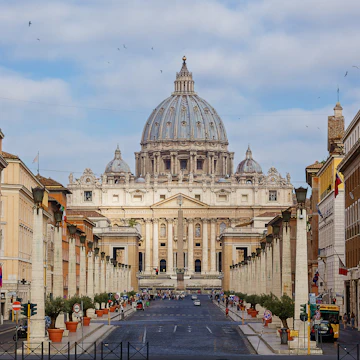
From above, Piazza San Pietro looks like a giant keyhole. The square's creator, Bernini, described the double colonnade as 'the motherly arms of the church'. He'd planned for the square to gob-smack pilgrims as they emerged from the tangle of medieval streets, an effect spoilt when Mussolini bulldozed Via della Conciliazione through the area. Caligula shipped in the central obelisk from Heliopolis, and it was later used by Christian-culling Nero as a turning post at his chariot-racing circus.
reviewed
-
P
La Botticella
On a quiet Trastevere backstreet, La Botticella offers pure Roman cooking, outside under the lines of flapping washing, or inside in the picture-lined salon. Menu stalwarts include tripe and rigatoni alla paiata (pasta with calf’s intestines), but there are less demanding dishes, such as an excellent spaghetti all’amatriciana and fritto alla botticella (deep-fried vegetables).
reviewed
-
Q
Buca di Ripetta
Popular with actors and directors from the district, who know a good thing when they see it, this value-for-money foodie destination offers robust Roman cuisine. Try the zuppa rustica con crostini do pane aromatizzati (country-style soup with rosemary-scented bread) or the matolino do latte al forno alle erbe con patate (baked suckling pork with potatoes) and you’ll be fuelled either for more sightseeing or for a lie down.
reviewed
-
R
Il Bacaro
Not an easy one to find, this cosy, romantic restaurant is tucked away in a tiny piazza north of the Pantheon. But it’s worth persevering because the food is top notch. Imaginative primi include risottos and soups, while mains feature both fish and meat dishes. Summer seating spills out under a vine-covered pergola. Booking is recommended.
reviewed
-
S
Da Enzo
This snug dining room with rough yellow walls and lots of character serves up great, seasonally based Roman meals, such as spaghetti with clams and mussels or grilled lamb cutlets. There's a tiny terrace on the quintessential Trastevere cobbled street.
reviewed
-
T
Freni e Frizioni
All the young dudes' favourite cool Trastevere bar was a garage in a former life, hence its name ('brakes and clutches'). The arty crowd flocks here to slurp well-priced drinks (especially mojitos), feast on the good-value aperitivo and spill into the piazza out the front.
reviewed
Advertisement
-
U
Akab
This eclectic former workshop has an underground cellar, an upper floor, a garden and a whimsical door policy. On Tuesdays it's electronica L'Etrika, while it goes hip hop and R&B on Thursday. Expect local live (often cover) bands on Friday, R&B and house on Saturday. Entrance is €15, including a complimentary drink.
reviewed
-
V
Matricianella
With its gingham tablecloths and chintzy murals, this popular trattoria is loved for its traditional Roman cuisine. You’ll find all the usual menu stalwarts as well as some great Roman-Jewish dishes. Romans go crazy for the fried antipasti, the artichoke alla giudia (fried, Jewish style) and the meatballs. Booking is essential.
reviewed
-
W
Bar del Fico
At the time of writing Bar del Fico was undergoing some works to shore up its façade. By the time you read this, fingers crossed, this long-standing favourite of the capital's bohemians will have reopened and you can return to while away days and nights at its fig-tree-shaded tables. The elderly chess players never left: they carried on their games in the cobbled street beside the building site.
reviewed
-
X
Sora Lella
You can’t beat the romance of Sora Lella’s setting on the river Tiber’s tiny island. Ring the doorbell to gain entrance to this timeless institution, named after the much-loved Roman TV star (the owner’s mother), and family-run since 1940. The classic Roman menu has some twists, including some wonderful fish dishes – try the standout paccheri con ragù di pesce (giant pasta tubes served with a tomato seafood sauce).
reviewed
-
Y
Babette
You’re in for a feast at Babette’s, which has a chic yet unpretentious brasserie-style interior of exposed brick walls and vintage painted signs. Food is delicious, with a sophisticated, creative, French twist (think tortiglioni with courgette and pistachio pesto), and the wine list is short but super. There’s a daily buffet (€10 Tuesday to Friday, €25 weekends).
reviewed