go to content go to search box go to global site navigation

Iran

Sights in Iran

  1. Covered Bazaar

    The extensive, much restored covered bazaar slopes up from Modarres St. It's well worth exploring with a couple of dilapidated old caravanserai courtyards at the western end. Within the bazaar, Ehmad Dohla Mosque (Jewellery Bazaar), entered through an attractive tiled portal, has a Qajar-era clock tower.

    reviewed

  2. A

    Niyavaran Palace Museum

    The Niyavaran Palace Museum, the complex where Shah Mohammad Reza Pahlavi and his family spent most of the last 10 years of royal rule. It’s set in five hectares of landscaped gardens and has four separate museums – tickets must be bought individually at the main gate.

    reviewed

  3. Foreign Pilgrims Assistance Office

    Friendly, multilingual staff at the Foreign Pilgrims Assistance Office can show you a 20-minute video about the Haram and shower you with books on all things Shiite. However, once you've visited this office there's no escape from the free, friendly but over-protective guide/minder they assign you.

    reviewed

  4. B

    Iranian Photographers’ Centre

    The Iranian Photographers’ Centre has rolling exhibits of the work of local and, occasionally, international photographers. The adjoining shop sells and processes slide film and sells pro equipment. Not surprisingly, it’s a good place to meet Iranian photographers.

    reviewed

  5. Post House

    About 52km north of Yazd, Meybod is a sprawling mud-brick town that is at least 1800 years old. It has three main sights near each other in the west of town, all open from 9am to 5pm, or 7pm in summer. They include a 300-year-old post house that served as a relay station on.

    reviewed

  6. Jameh Mosque

    The mud-daub walled 1285 Jameh Mosque backs onto the fine 1313 Borj Kashani, a circular tomb-tower that possibly doubled as an astronomical observatory like that at Radkan. The mosque reportedly contains superb stucco-work but getting in can be hit-and-miss.

    reviewed

  7. Church of Bethlehem

    The frescoes on the walls and ceilings of the Church of Bethlehem, built in 1628, are arguably of a higher quality. The interior of the high dome is decorated with swirling black motifs on a golden background, while the base is surrounded by paintings of Biblical scenes.

    reviewed

  8. Aks Khaneh

    The Aks Khaneh is one of the highlights of the Golestan complex. The photographs depicting Qajar court life are fascinating; look particularly for the picture showing the inside of a Zoroastrian tower of silence, with bodies in varying states of decay, and the shot of 'freaks and dwarfs'.

    reviewed

  9. Median Citadel

    Sitting on an abrupt pimple of hill amid flat, comparatively fertile plains this unique Median Citadel originally hosted the fortified grain stores and temples of a 7th-century BC settlement. It’s relatively small and shaded by steel-girders with ugly shed-roofing

    reviewed

  10. Museum

    A Unesco-sponsored museum is beautifully set amid bougainvillaea and soaring palms. It displays archaeological finds including a curious black sarcophagus. Photo-rich explanations detail the excavation, restoration and partial reconstruction of Choqa Zanbil (25km away).

    reviewed

  11. Advertisement

  12. Ehmad Dohla Mosque

    The extensive, much restored covered bazaar slopes up from Modarres St. It's well worth exploring with a couple of dilapidated old caravanserai courtyards at the western end. Within the bazaar, Ehmad Dohla Mosque, entered through an attractive tiled portal, has a Qajar-era clock tower.

    reviewed

  13. Winter Hall

    To fully appreciate the Jameh Mosque you must go into the fine interior rooms. Next door to the Room of Sultan Uljeitu is the Timurid-era Winter Hall, built in 1448 and lit by alabaster skylights - ask the caretaker to turn off the neon (or do it yourself) to see the full effect.

    reviewed

  14. Cliff-Caves

    These intriguing four-storey cliff-caves are normally visited from Divandareh (67km to the south), but should soon be accessible via an improved road from Takab. An antique inscription within says in Greek: ‘Hercules lives here: no evil may enter’.

    reviewed

  15. Moslem Mirzazadeh

    Recently renovated, the building itself is worth a look for the small display on the old city of Yazd, the clean toilets, the overly fluorescent but mercifully cool subterranean teahouse and the studio-shop of sitar-maker and -player Moslem Mirzazadeh.

    reviewed

  16. C

    Constitution House

    This charming Qajar-era courtyard house is historically significant as a headquarters during the 1906–11 constitutional revolution, but although many labels are in English the numerous photos and documents are unlikely to excite non-specialist tourists.

    reviewed

  17. Naqsh-e Rajab

    Naqsh-e Rajab, on the old Shiraz–Esfahan road and is worth a quick look. Four fine Sassanian bas-reliefs are hidden from the road by the folds of a rocky hill and depict various scenes from the reigns of Ardashir I and Shapur the Great.

    reviewed

  18. Elgoli (Shahgoli) Park

    Elgoli (Shahgoli) Park, 8km southeast of the centre, is popular with summer strollers and courting couples. Its fairground surrounds an artificial lake, in the middle of which a photogenic restaurant-pavilion occupies the reconstruction of a Qajar-era palace.

    reviewed

  19. Azadi Tower (Borj-e Azadi)

    Way out west at the end of Azadi Ave is the inverted Y-shaped Azadi Tower, built to commemorate the 2500th anniversary of the Persian Empire in 1971. There's an underground gallery, Quran museum, cinema and, best of all, viewing platform.

    reviewed

  20. Talar-e Almas

    The tiny Talar-e Almas displays a range of decorative arts - especially 18th- and 19th-century French ceramics - in a room with red walls and a tiled floor. It's not the most riveting room in the palace. The teahouse underneath was closed when we visited.

    reviewed

  21. D

    Madraseh-ye Chahar Bagh

    The Madraseh-ye Chahar Bagh was built between 1704 and 1714 as part of an expansive complex that included a caravanserai (now the Abbasi Hotel) and the Bazar-e Honar. Revenues from these buildings paid for the upkeep of the madraseh.

    reviewed

  22. Advertisement

  23. Edifice

    This huge brick edifice, an unmissable landmark, is a chunky remnant of Tabriz’s early-14th- centurycitadel (known as ‘the Ark’). Criminals were once executed by being hurled from the top of the citadel walls.

    reviewed

  24. Pasargadae

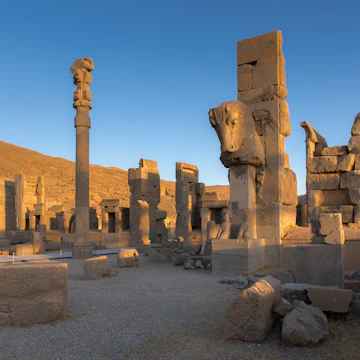
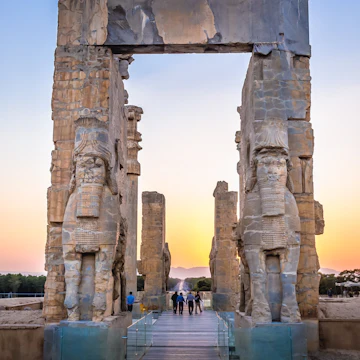
    Begun under Cyrus the Great in about 546 BC, the city of Pasargadae was quickly superseded by Darius I’s magnificent palace at Persepolis. The site is not nearly as well preserved as Persepolis, but is beautiful in a lonely, windswept way.

    reviewed

  25. Howze Khaneh

    The Howze Khaneh is named for the small pool and fountain in the centre of the room. It houses a collection of paintings and sculptures of 19th-century European royalty - generously given to their Qajar counterparts by the same European monarchs.

    reviewed

  26. Ateshkadeh-ye Esfahan

    Dating from Sassanian times, the crumbling mud bricks of the Ateshkadeh-ye Esfahan stare out over the Zayandeh River and the city from a low hill on its outskirts. The 10-minute scramble uphill is worth the effort on a clear day.

    reviewed

  27. E

    Natural History Museum

    A large 15th-century building is home to the Natural History Museum, where the fibreglass dinosaurs out front are not that enticing. The exhibits inside are better but won’t have you rushing off to write home about them.

    reviewed