Sights in Haiti
- Sort by:
- Popular
-
Parc National Historique La Citadelle
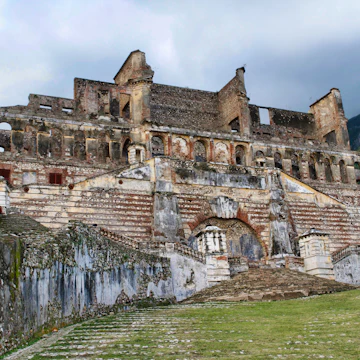
It took Henri Christophe 15 years to build this vast mountaintop fortress, constructed to combat another invasion by the French. The astounding structure, with its shiplike appearance, is balanced on top of the 900m (2952ft) Pic la Ferrière and overlooks Cap-Haïtien, the northern plain and routes leading to the south.
The fortress was completed in 1820, having employed up to 20,000 people, many of whom died during the arduous task. With 4m/13ft-thick walls that reach heights of 40m (131ft), the fortress was impenetrable. It held enough supplies to sustain the royal family and a garrison of 5000 troops for a year. It still contains over 100 cannons and an arsenal of…
reviewed
-
A
Marché de Fer
Several of Haiti’s cities have Iron Markets, but the original and best is in central Port-au-Prince. The Marché de Fer is an exuberant and exotic red-metal structure dating from 1889, which looks more akin to something from the Arabian Nights than tropical Haiti. In fact, it was originally destined to be the main hall of Cairo train station (hence its minarets), but when the sale from the Parisian manufacturers fell through, President Florvil Hyppolite snapped it up as part of his plan to modernize Port-au-Prince.
reviewed
-
Musée du Panthéon National
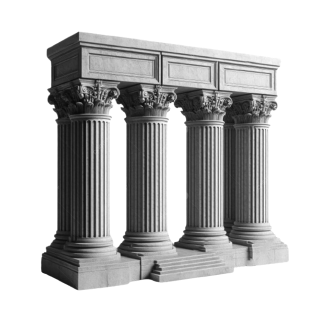
The Musée du Panthéon National is a modern, mostly subterranean museum set in its own gardens. Its unusual design echoes the houses of Haiti’s original Taíno inhabitants, a motif repeated by the conical central ‘well’ bringing light to illuminate the gold monument recreating the cannons and banners found on the national flag. The bodies of Toussaint Louverture, Dessalines, Christophe and Pétion are interred below, and the names of further heroes of the independence struggle marked on the surrounding walls.
reviewed
-
Bassins Bleu
The Bassins Bleu are three cobalt-blue pools joined by spectacular cascades. Dissolved minerals give the falls their distinctive colour. According to legend, water nymphs live in the grottos and sun themselves on a rock in Palm Lake, but disappear at the sound of mortal footsteps. Given the number of mortals hanging around, you probably won't see them.
reviewed
-
B
Musée d’Art Haïtien
The Musée d’Art Haïtien, on the southern edge of Champs de Mars, is something of a curate’s egg. It holds probably the largest collection of Haiti’s naive art, with masters like Hector Hyppolite, Préfète Duffaut, Philomé Obin and Robert St Brice well represented. Unfortunately the works aren’t hung well, and the permanent collection isn’t always on display. Instead you have to take potluck as to what’s on show, although the rotating exhibitions can be very good and sometimes branch out into photography.
reviewed
-
C
Centre d’Art
The Centre d’Art is in a two-floor gingerbread house on a quiet street south of Champs de Mars. It was opened in 1944 by De Witt Peters as both school and exhibition space to encourage the new breed of Haitian painters. Through its work the Centre d’Art helped give painters such as Hyppolite, Obin and Bigaud the recognition they deserved, and was of such importance in the development of Haitian art that its opening is often referred to as ‘the miracle of 1944.’
reviewed
-
D
Sainte Trinité Episcopalian Cathedral
From the outside, this cathedral, just north of Champs de Mars, doesn’t look architecturally inspiring – a large but essentially unimpressive pale brick building. But the quiet exterior hides an amazing secret, as the inside is covered with joyously exuberant murals marking out the life of Christ, executed by the great masters of Haitian painting.
reviewed
-
E
Salubria Gallery
The Salubria Gallery is an eclectic gallery in a blue-and-white fin-de-siècle house owned by American professor Robert Bricston. The walls are packed with paintings, even the bathrooms and bedrooms; you trail around the whole house, looking at a collection that includes most of the masters of Haitian art.
reviewed
-
F
Grand Rue Artists
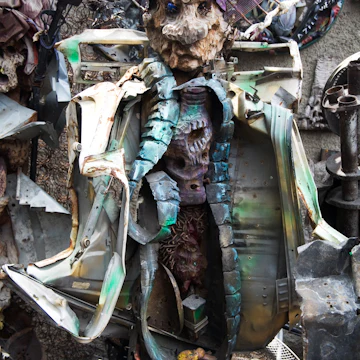
The Grand Rue artists are unlike anything you’ve seen in Haiti, turning scrap and found objects into startling Vodou sculpture. The results are a heady mix of spirit, sex and politics – a Caribbean junkyard gone cyberpunk, yet one very much grounded in the preoccupations of daily Haitian life.
reviewed
-
Étang Saumâtre
This is the place to come if you are interested in looking at some local flora and fauna. Haiti's largest saltwater lake supports over 100 species of waterfowl, flamingos and American crocodiles. It's an intense shade of blue and skirted by brush and cacti.
reviewed
Advertisement
-
G
Maison Cadet
A key building to look out for is the grand Maison Cadet, with its red-iron ‘witch’s hat'.
reviewed
-
H
Cathédrale de St Phillippe et St Jacques
This pretty white cathedral built in 1859 is close to the market.
reviewed
-
I
Notre Dame Catholic Cathedral
Two blocks north of Sainte Trinité in Bel Air this cathedral is the city’s largest ecclesiastical building. Completed in 1912, the pink-and-yellow structure has two domed towers on its west face. The cathedral itself was one of the first in the world to be built from reinforced concrete, and as such had to receive special dispensation from the Vatican to be consecrated. Worshippers fervently pray on the cathedral steps, at the gates and around the walls, alongside beggars and small stalls selling Catholic ephemera.
reviewed