Things to do in London
-
A
Hyde Park
At 145 hectares, Hyde Park is central London's largest open space. Henry VIII expropriated it from the Church in 1536, when it became a hunting ground and later a venue for duels, executions and horse racing. The 1851 Great Exhibition was held here, and during WWII the park became an enormous potato field. These days, it serves as an occasional concert venue and a full-time green space for fun and frolics. There's boating on the Serpentine for the energetic, while Speaker's Corner is for oratorical acrobats. These days, it's largely nutters and religious fanatics who address the bemused stragglers at Speaker's Corner, maintaining the tradition begun in 1872 as a response…
reviewed
-
B
Dr Johnson’s House
This wonderful house, built in 1700, is a rare surviving example of a Georgian city mansion. All around it today huge office blocks loom and tiny Gough Square can be quite hard to find. The house has been preserved, as it was the home of the great Georgian wit Samuel Johnson, the author of the first serious dictionary of the English language and the man who proclaimed ‘When a man is tired of London, he is tired of life’.
The museum doesn’t exactly crackle with Dr Johnson’s immortal wit, yet it’s still an atmospheric and worthy place to visit, with its antique furniture and artefacts from Johnson’s life. The numerous paintings of Dr Johnson and his associates, including…
reviewed
-
C
Bank of England Museum
When William III declared war against France in the 17th century, he looked over his shoulder and soon realised he didn’t have the funds to finance his armed forces. A Scottish merchant by the name of William Paterson came up with the idea of forming a joint-stock bank that could lend the government money and, in 1694, so began the Bank of England and the notion of national debt. The bank rapidly expanded in size and stature and moved to this site in 1734. During a financial crisis at the end of the 18th century, a cartoon appeared depicting the bank as a haggard old woman, and this is probably the origin of its nickname ‘the Old Lady of Threadneedle St’. The institution…
reviewed
-
D
Imperial War Museum
Fronted by a pair of intimidating 15in naval guns, this riveting museum is housed in what was once Bethlehem Royal Hospital, also known as Bedlam. Although the museum's focus is on military action involving British or Commonwealth troops during the 20th century, it rolls out the carpet to war in the wider sense. There's not just Lawrence of Arabia's 1000cc motorbike, but a German V-2 rocket, a Sherman tank and a lifelike replica of Little Boy (the atom bomb dropped on Hiroshima).
In the Trench Experience on the lower ground floor you walk through the grim reality of life on the Somme front line in WWI; the Blitz Experience has you cowering inside a mock bomb shelter…
reviewed
-
E
St James’s Park
This is one of the smallest but most gorgeous of London’s parks. It has brilliant views of the London Eye, Westminster, St James’s Palace, Carlton Terrace and Horse Guards Parade, and the view of Buckingham Palace from the footbridge spanning St James’s Park Lake is the best you’ll find. The central lake is full of different types of ducks, geese, swans and general fowl, and its southern side’s rocks serve as a rest stop for pelicans (fed at 2.30pm daily). Some of the technicolour flowerbeds were modelled on John Nash’s original ‘floriferous’ beds of mixed shrubs, flowers and trees. Spring and summer days see Londoners and tourists alike sunbathing, picnicking, admiring…
reviewed
-
F
Hampstead Heath
Sprawling Hampstead Heath, with its rolling woodlands and meadows, feels a million miles away – despite being approximately four – from the City of London. It covers 320 hectares, most of it woods, hills and meadows, and is home to about 180 bird species, 23 species of butterflies, grass snakes, bats and a rich array of flora. It's a wonder-ful place for a ramble, especially to the top of Parliament Hill, which offers expansive views across the city and is one of the most popular places in London to fly a kite. Alternatively head up the hill in North Wood or lose your-self in the West Heath.
If walking is too pedestrian for you, another major attraction is the bathing…
reviewed
-
G
Charterhouse
You need to book six months in advance to see inside this former Carthusian monastery, where the centrepiece is a Tudor hall with a restored hammerbeam roof. Its incredibly popular two-hour guided tours begin at the 14th-century gatehouse on Charterhouse Square, before going through to the Preachers’ Court, the Master’s Court, the Great Hall and the Great Chamber, where Queen Elizabeth I stayed on numerous occasions.
The monastery was founded in 1371 by the Carthusians, the strictest of all Roman Catholic monastic orders, refraining from eating meat and taking vows of silence, broken only for three hours on Sunday. During the Reformation the monastery was oppressed,…
reviewed
-
H
Central Criminal Court (Old Bailey)
Just as fact is often better than fiction, taking in a trial in the ‘Old Bailey’ leaves watching a TV courtroom drama for dust. Of course, it’s too late to see author Jeffrey Archer being found guilty of perjury here, watch the Guildford Four’s convictions being quashed after their wrongful imprisonment for IRA terrorist attacks, or view the Yorkshire Ripper Peter Sutcliffe being sent down. However, the Old Bailey is a byword for crime and notoriety. So even if you sit in on a fairly run-of-the-mill trial, simply being in the court where such people as the Kray twins and Oscar Wilde (in an earlier building on this site) once appeared is memorable in itself.
Choose…
reviewed
-
I
Apsley House
This stunning house, containing exhibits about the Duke of Wellington, was once the first building to appear when entering London from the west and was therefore known as 'No 1 London'. Still one of London's finest, Apsley House was designed by Robert Adam for Baron Apsley in the late 18th century, but later sold to the first Duke of Wellington, who lived here until he died in 1852. In 1947 the house was given to the nation, which must have come as a surprise to the duke's descendants, who still live in a flat here; 10 of its rooms are open to the public. Wellington memorabilia, including his death mask, fills the basement gallery, while there's an astonishing collection…
reviewed
-
J
National Portrait Gallery
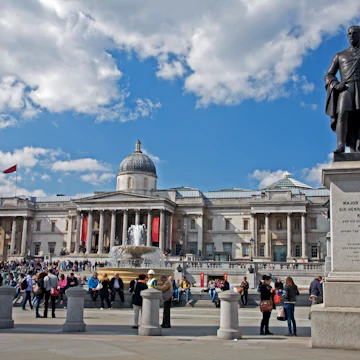
The fascinating National Portrait Gallery is like stepping into a picture book of English history. Founded in 1856, the permanent collection (around 11,000 works) starts with the Tudors on the 2nd floor and descends to contemporary figures (from pop stars to scientists), including Marc Quinn's Self, a frozen self-portrait of the artist's head cast in blood and recreated every five years. An audiovisual guide (£3) will lead you through the gallery's most famous pictures.
reviewed
Advertisement
-
K
30 St Mary Axe (Gherkin)
Known to one and all as ‘the ’ (for obvious reasons when you see its incredible shape), 30 St Mary Axe – as it is officially and far more prosaically named – remains London’s most distinctive skyscraper, dominating the city despite actually being slightly smaller than the neighbouring NatWest Tower. The phallic Gherkin’s futuristic, sci-fi exterior has become an emblem of modern London as recognisable as Big Ben or the London Eye.
Built in 2002–03 to a multi-award- winning design by Norman Foster, this is London’s first ecofriendly skyscraper: Foster laid out the offices so they spiral around internal ‘sky gardens’. The windows can be opened and the gardens…
reviewed
-
L
Museum of London
One of the capital's best museums, this is a fascinating walk through the various incarnations of the city from An-glo-Saxon village to 21st-century metropolis. The first gallery, London Before London, brings to life the ancient settlements that predated the capital and is followed by the Roman era, full of interesting displays and models. The rest of the floor takes you through the Saxon, medieval, Tudor and Stuart periods, culminating in the Great Fire of 1666. From here head down to the modern galleries, opened in 2010, where, in Expanding City, you'll find exquisite fashion and jewellery, the graffitied walls of a prison cell (1750) and the Rhinebeck Panorama, a…
reviewed
-
M
St John’s Gate
This surprisingly out-of-place medieval gate cutting across St John’s Lane is no modern folly, but the real deal. During the 12th century, the crusading Knights of St John of Jerusalem (a religious and military order with a focus on providing care to the sick) established a priory on this site that originally covered around 4 hectares. The gate was built in 1504 as a grand entrance to the priory and although most of the buildings were destroyed when Henry VIII dissolved every monastery in the country between 1536 and 1540, the gate lived on. It had a varied afterlife, not least as a Latin-speaking coffee house run, without much success, by William Hogarth’s father during…
reviewed
-
N
Barbican
Londoners remain fairly divided about the architectural legacy of this vast housing and cultural complex in the heart of the City. While the Barbican is named after a Roman fortification that may once have stood here protecting ancient Londinium, what you see today is very much a product of the 1960s and ‘70s. Built on a huge bomb site abandoned since WWII and opened progressively between 1969 and 1982, it’s fair to say that its austere concrete isn’t everyone’s cup of tea. Yet, although it has topped several polls as London’s ugliest building, many Londoners see something very beautiful about its cohesion and ambition – incorporating Shakespeare’s local church,…
reviewed
-
O
Southbank Centre
The flagship venue of the Southbank Centre, the collection of concrete buildings and walkways shoehorned between Hungerford and Waterloo Bridges, is the Royal Festival Hall. It is the oldest building of the centre still standing, having been erected to cheer up a glum postwar populace as part of the 1951 Festival of Britain. Its slightly curved facade of glass and Portland stone always won it more public approbation than its 1970s neighbours, but a recent £90-millionrefit added new pedestrian walkways, bookshops, music stores and food outlets below it, including a restaurant called Skylon. Just north, Queen Elizabeth Hall is the second-largest concert venue in the centre…
reviewed
-
P
Horniman Museum
This museum is an extraordinary place, comprising the original collection of wealthy tea merchant Frederick John Horniman, a pack rat who had the art nouveau building with clock tower and mosaics specially designed to house it in 1901. Today it encompasses everything from a dusty stuffed walrus and voodoo altars from Haiti and Benin to a mock-up of a Fijian reef and a collection of concertinas. It’s wonderful. On the ground and 1st floors is the Natural History Gallery, the core of the Horniman collection, with usual animal skeletons and pickled specimens. On the lower ground floor you’ll find the African Worlds Gallery, the first permanent gallery of African and…
reviewed
-
Q
Temple Church
This magnificent church lies within the walls of the Temple, built by the legendary Knights Templar, an order of crusading monks founded in the 12th century to protect pilgrims travelling to and from Jerusalem. The order moved here around 1160, abandoning its older headquarters in Holborn. Today the sprawling oasis of fine buildings and pleasant traffic-free green space is home to two Inns of Court (housing the chambers of lawyers practising in the City) and the Middle and the Lesser Temple.
The Temple Church has a distinctive design: the Round (consecrated in 1185 and designed to recall the Church of the Holy Sepulchre in Jerusalem) adjoins the Chancel (built in 1240),…
reviewed
-
R
Royal Observatory
Following an ambitious £15-million renovation the Royal Observatory is now divided into two sections.
The northern half deals with time and is contained in the original Observatory that Charles II had built on a hill in the middle of Greenwich Park in 1675, intending that astronomy be used to establish longitude at sea. It contains the Octagon Room, designed by Wren, and the nearby Sextant Room where John Flamsteed (1646–1719), the first astronomer royal, made his observations and calculations.
The globe is divided between east and west at the Royal Observatory, and in the Meridian Courtyard you can place one foot either side of the meridian line and straddle the two…
reviewed
-
S
The Strand
From the time it was built, at the end of the 12th century, The Strand (from the Old English and German word for beach) ran by the Thames. Its grandiose stone houses, built by the nobility, counted as some of the most prestigious places to live, sitting as they did on a street that connected the City and Westminster, the two centres of power; indeed, its appeal lasted for seven centuries, with the 19th-century prime minister Benjamin Disraeli pronouncing it ‘the finest street in Europe’. Buildings included the now-no-more Cecil Hotel, the Savoy hotel, Simpson’s, King’s College and Somerset House. But modern times haven’t treated The Strand with the same sort of respect…
reviewed
-
T
Museum in Docklands
Housed in a converted 200-year-old warehouse once used to store sugar, rum and coffee, this museum offers a comprehensive overview of the entire history of the Thames from the arrival of the Romans in AD 43. But it’s at its best when dealing with specifics close by such as the controversial transformation of the decrepit docks into Docklands in the 1980s. The tour begins on the 3rd floor (take the lift to the top) with the Roman settlement of Londinium – don’t miss the delightful Roman blue-glass bowl discovered in pieces at a building site in Prescot St E1 in 2008 – and works its way downwards through the ages. Keep an eye open for the scale mode of the old London Bridge…
reviewed
Advertisement
-
U
Regent’s Park
The most elaborate and ordered of London’s many parks, this one was created around 1820 by John Nash, who planned to use it as an estate to build palaces for the aristocracy. Although the plan never quite came off – like so many at the time – you can get some idea of what Nash might have achieved from the buildings along the Outer Circle, and in particular from the stuccoed Palladian mansions he built on Cumberland Tce.
Like many of the city’s parks, this one was used as a royal hunting ground, and then as farmland, before becoming a place for fun and leisure during the 18th century. These days it’s well organised but relaxed, lively but serene, and a local but…
reviewed
-
V
Crossbones Graveyard
One of the area’s more unconventional sights is this unconsecrated post-medieval burial ground. A 16th century ‘single women’s graveyard’, this is the burial place for prostitutes who worked in the brothels of Southwark. Despite being licensed to work here by the Bishop of Winchester (giving them their popular name, ‘Winchester geese’), the women were excluded from Christian burial, and by the 18th century the local parish was using the grounds for dumping the remains of paupers. It was closed down in the 19th century due to high numbers of bodies buried here; there were serious sanitation issues caused by the gravediggers’ sloppy burial technique that left many of the…
reviewed
-
W
Somerset House
The first Somerset House was built for the Duke of Somerset, brother of Jane Seymour, in 1551. For two centuries it played host to royals (Elizabeth I once lived here), foreign diplomats, wild masked balls, peace treaties, the Parliamentary army (during the Civil War) and Oliver Cromwell's wake. Having fallen into disrepair, it was pulled down in 1775 and rebuilt in 1801 to designs by William Chambers. Among other weighty organisations, it went on to house the Royal Academy of the Arts, the Society of Antiquaries, the Navy Board and, that most popular of institutions, the Inland Revenue.
The tax collectors are still here, but that doesn't dissuade Londoners from attending…
reviewed
-
X
Richmond Park
At 1012 hectares (the largest urban parkland in Europe), this park offers everything from formal gardens and ancient oaks to unsurpassed views of central London 12 miles away. It’s easy to escape the several roads that slice up the rambling wilderness, making the park excellent for a quiet walk or a picnic with the kids, even in summer when Richmond’s riverside can be heaving. Herds of more than 600 red and fallow deer basking under the trees are part of its magic, but they can be less than docile in rutting season (May to July) and when the does bear young (September and October). Birdwatchers will love the diverse habitats, from neat gardens to woodland and assorted…
reviewed
-
Y
Alexandra Park & Palace
Built in 1873 as North London’s answer to Crystal Palace, Alexandra Palace suffered the ignoble fate of burning to the ground only 16 days after opening. Encouraged by attendance figures, investors decided to rebuild and it reopened just two years later. Although it boasted a theatre, museum, lecture hall, library and Great Hall with one of the world’s largest organs, it was no match for Crystal Palace. It housed German prisoners of war during WWI and in 1936 was the scene of the world’s first TV transmission – a variety show called Here’s Looking at You. The palace burned down again in 1980 but was rebuilt for the third time and opened in 1988. Today ‘Ally…
reviewed