go to content go to search box go to global site navigation

Dominican Republic

Sights in Dominican Republic

‹ Prev

of 2

  1. Punta Cana Ecological Park

    A half-kilometer south of Punta Cana Resort and Club, the Punta Cana Ecological Park covers almost 8 sq km of protected coastal and inland habitat and is home to some 80 bird species, 160 insect species and 500 plant species. Visitors can take very worthwhile 90-minute guided tours taken in English, French, German or Spanish through a lush 18-hectare portion of the reserve known as Parque Ojos Indígenas (Indigenous Eyes Park), so named for its 11 freshwater lagoons all fed by an underground river that flows into the ocean. The tour also includes a visit to the park’s botanical and fruit gardens, iguana farm (part of a breeding program) and a farm-animal petting zoo. The…

    reviewed

  2. Jardín Botánico Nacional

    The lush grounds of the Jardín Botánico Nacional span 2 sq km and include vast areas devoted to aquatic plants, orchids, bromeliads, ferns, endemic plants, palm trees, a Japanese garden and much more. Great care is taken to keep the grounds spotless and the plants well tended, and it’s easy to forget you’re in the middle of a city of over two million people. In fact, birders can contact Tody Tours for an expert eye on the many species found here. The garden hosts a variety of events, including an orchid exhibition and competition in March and a bonsai exhibition in April. The on-site Ecological Museum exhibits and explains the major ecosystems found in the DR,…

    reviewed

  3. Museo de las Casas Reales

    One of the interesting museums, partly because of its history and the high quality of its exhibits, near Plaza España. Built in the Renaissance style during the 16th century, it was the longtime seat of Spanish authority for the entire Caribbean region, housing the Governor’s office and the powerful Audiencia Real (Royal Court), among others. It showcases colonial-period objects, including many treasures recovered from Spanish galleons that foundered in nearby waters. Several walls are covered with excellent maps of various voyages of European explorers and conquistadors. Each room has been restored according to its original style, and displays range from Taíno artifacts…

    reviewed

  4. Parque Zoológico Nacional

    One of the larger zoos in all Latin America, the Parque Zoológico Nacional is a dismal collection of cramped, bare enclosures that will leave you fearing for the future of the natural world. The collection of animals is extensive: rhinos and chimps, flamingos and the endangered solenodon, an extremely rare, rat-like creature endemic to the island. Located in a somewhat seedy neighborhood in the northwest corner of the city (the makeshift homes of the slum perched just above the zoo appear as if they’re likely to collapse onto the property at any moment), it’s a bit hard to find. A taxi here from the Zona Colonial costs around US$6; definitely be sure to arrange a return…

    reviewed

  5. Casa del Cordón

    Said to be not only one of the first European residences in the Americas, but also one of the first residences in the Western hemisphere with two floors, Casa del Cordón was briefly occupied by Diego Columbus and his wife before they moved into their stately home down the street. Named after its impressive stone façade, which is adorned with the chiseled sash-and-cord symbol of the Franciscan order, it is also believed to be the site where Santo Domingo’s women lined up to hand over their jewels to Drake during the month he and his men held the city hostage. Today the structure is home to Banco Popular, and while you can go in to exchange money, visiting the house beyond…

    reviewed

  6. Monasterio de San Francisco

    The Monasterio de San Francisco was the first monastery in the New World and belonged to the first order of Franciscan friars who arrived to evangelize the island. Dating from 1508, the monastery originally consisted of three connecting chapels. It was set ablaze by Drake in 1586, rebuilt, devastated by an earthquake in 1673, rebuilt, ruined by another earthquake in 1751 and rebuilt again. From 1881 until the 1930s it was used as a mental asylum until a powerful hurricane shut it down – portions of chains used to secure inmates can still be seen. The buildings were never repaired. Today the monastery is a dramatic set of ruins that is occasionally used to stage concerts…

    reviewed

  7. Ruinas del Hospital San Nicolás de Barí

    Standing next to a bright, white Iglesia de la Altagracia are the Ruinas del Hospital San Nicolás de Barí, ruins of the New World’s first hospital. They remain in place as a monument to Governor Nicolás de Ovando, who ordered the hospital built in 1503. So sturdy was the edifice that it survived Drake’s invasion and centuries of earthquakes and hurricanes. It remained virtually intact until 1911, when after being devastated by a hurricane, public-works officials ordered much of it knocked down so that it wouldn’t pose a threat to pedestrians. Even today visitors can still see several of its high walls and Moorish arches. Note that the hospital’s floor plan follows the…

    reviewed

  8. Museo del Hombre Dominicano

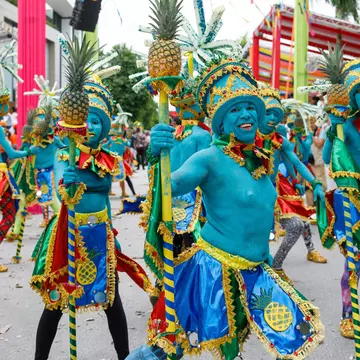
    The most extensive of the museums is the Museo del Hombre Dominicano. Highlights are the impressive collection of Taíno artifacts, including stone axes and intriguing urns and carvings, and the small but interesting section on Carnival, with the masks and costumes used in various cities around the country. Other sections focus on slavery and the colonial period, African influences in the DR (including a small section on Vodou) and contemporary rural Dominican life. Unfortunately, the explanations are all in Spanish and the displays very old-fashioned. English-speaking guides can be requested at the entry – the service is free, but small tips are customary.

    reviewed

  9. Parque Mirador Del Sur

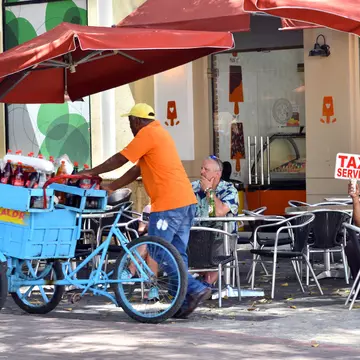
    A long tree-filled corridor atop an enormous limestone ridge, Parque Mirador Del Sur is riddled with caves, some as big as airplane hangars. One of the caves has been converted into a restaurant, another into a dance club. The park’s seemingly endless paths are a popular jogging spot for 30-something professionals, many of whom live in the middle- and upper-class neighborhoods north of the park. Av Mirador del Sur is closed to traffic from 6am to 9am and 4pm to 8pm daily, when it fills with men and women jogging, rollerblading and bicycling up and down the broad avenue, and mobile juice bars and snack stands for anyone who’s hungry.

    reviewed

  10. Casa de Francia

    The Casa de Francia was originally the residence of Hernán Cortés, conqueror of the Aztecs in what is today central Mexico. It was in this building that Cortés is believed to have organized his triumphant – and brutal – expedition. Built in the early 16th century and sharing many elements with the Museo de las Casas Reales, experts theorize that these buildings were designed by the same master; both have a flat façade and a double bay window in the upper and lower stories, repeating patterns of doors and windows on both floors, and top-notch stone rubblework masonry around the windows, doors and corner shorings.

    reviewed

  11. Advertisement

  12. Museo Alcázar de Colón

    Designed in the Gothic-Mudéjar transitional style, the Museo Alcázar de Colón was used as a residence by Columbus’ son, Diego, and his wife, Doña María de Toledo, during the early 16th century. Recalled to Spain in 1523, the couple left the home to relatives who occupied the handsome building for the next hundred years. It was subsequently allowed to deteriorate, then was used as a prison and a warehouse, before it was finally abandoned. By 1775 it was a vandalized shell of its former self and served as the unofficial city dump. Less than a hundred years later, only two of its walls remained at right angles.

    reviewed

  13. Catedral Primada de América

    Diego Columbus, son of the great explorer, set the first stone of the Catedral Primada de América in 1514, but construction didn’t begin in earnest until the arrival of the first bishop, Alejandro Geraldini, in 1521. From then until 1540, numerous archi­tects worked on the church and adjoining buildings, which is why the vault is Gothic, the arches Romanesque and the ornamentation baroque. It’s anyone’s guess what the planned bell tower would have looked like: a shortage of funds curtailed construction, and the steeple, which undoubtedly would have offered a commanding view of the city, was never built.

    reviewed

  14. Los Tres Ojos

    Consisting of three very humid caverns with still, dark lagoons inside and connected by stalactite-filled passages, Los Tres Ojos is a mildly interesting site frequented by organized tours. The caves are limestone sinkholes, carved by water erosion over thousands of years. The entrance is a long stairway down a narrow tunnel in the rock; once at the bottom, cement paths lead you through the caves or you can visit them by boat for another US$0.35. Unfortunately, the tranquility of the setting is usually upset by vendors aggressively hawking their postcards and jewelry to tourists at the entrance.

    reviewed

  15. Fortaleza Ozama

    The Fortaleza Ozama is the oldest colonial military edifice in the New World. The site of the fort – at the meeting of the Río Ozama and the Caribbean was selected by Fray Nicolás de Ovando. Construction of the fortification began in 1502 under the direction of master builder Gómez García Varela and continued in various stages for the next two centuries. Over the course of its history, the fort has flown the flag of Spain, England, France, Haiti, Gran Columbia, the US and the DR. Until the 1970s, when it was opened to the public, it has served as a military garrison and prison.

    reviewed

  16. Panteón Nacional

    Originally constructed in 1747 as a Jesuit church, the Panteón Nacional was also a tobacco warehouse and a theater before dictator Trujillo restored the building in 1958 for its current usage. Today many of the country’s most illustrious persons are honored here, their remains sealed behind two marble walls. The entire building, including its neoclassical façade, is built of large limestone blocks. As befits such a place, an armed soldier is ever present at the mausoleum’s entrance along with a powerful fan since it does get hot. Shorts and tank tops are discouraged.

    reviewed

  17. Palacio Nacional

    The Dominican seat of government, the Palacio Nacional was designed by Italian architect Guido D’Alessandro and inaugurated in 1947. The palace is built of Samaná roseate marble in a neoclassical design and is outfitted in grand style with mahogany furniture, paintings from prominent Dominican artists, magnificent mirrors inlaid with gold, and a proportionate amount of imported crystal. Of special note is the Room of the Caryatids, in which 44 sculpted draped women rise like columns in a hall lined with French mirrors and Baccarat chandeliers.

    reviewed

  18. Convento de la Orden de los Predicadores

    Built in 1510 by Charles V, the Convento de la Orden de los Predicadores is the first convent of the Dominican order founded in the Americas. It also is where Father Bartolomé de las Casas the famous chronicler of Spanish atrocities committed against indigenous peoples – did most of his writing. Be sure to take a look at the vault of the chapel; it is remarkable for its stone zodiac wheel, which is carved with mythological and astrological representations. On the walls are various paintings of religious figures, including Pope Saint Pius V.

    reviewed

  19. Puerta del Conde

    The Puerta del Conde owes its name to the Count of Peñalba, Bernardo de Meneses y Bracamonte, who led the successful defense of Santo Domingo against an invading force of 13,000 British troops in 1655. The gate is the supreme symbol of Dominican patriotism because right beside it, in February 1844, a handful of brave Dominicans executed a bloodless coup against occupying Haitian forces; their actions resulted in the creation of a wholly independent Dominican Republic. It also was atop this gate that the very first Dominican flag was raised.

    reviewed

  20. Iglesia de Nuestra Señora de las Mercedes

    The Iglesia de Nuestra Señora de las Mercedes, constructed during the first half of the 16th century, was sacked by Drake and his men and reconstructed on numerous occasions following earthquakes and hurricanes. The church is remarkable for its pulpit, which is sustained by a support in the shape of a serpent demon. The intricate baroque altarpiece is carved from tropical hardwood. Of the group of buildings that pay homage to the Virgin Mary, only the cloister adjacent to the church is in original condition.

    reviewed

  21. Faro a Colón

    Resembling a cross between a Soviet-era apartment block and a Las Vegas version of an ancient Mayan ruin, the Faro a Colón is worth visiting for its controversial and complicated history. Located on the east side of the Río Ozama, the Faro’s massive cement flanks stretch nearly a block and stand some 10 stories high forming the shape of a cross. High-power lights on the roof can project a blinding white cross in the sky, but are rarely turned on because doing so causes blackouts in surrounding neighborhoods.

    reviewed

  22. Advertisement

  23. Museo de la Familia Dominicana

    Located in the Casa de Tostado – the beautifully restored 16th-century home of the writer Francisco Tostado – is the Museo de la Familia Dominicana. It’s as interesting as much for its architectural features (it has a double Gothic window over the front door – the only one of its kind in the Americas), as for its exhibits displaying well-restored 19th-century furnishings and household objects. Ask to go up the spiral mahogany staircase for a rooftop view of the Zona Colonial. Tours in Spanish only.

    reviewed

  24. Museo de Arte Moderno

    The permanent collection at the Museo de Arte Moderno includes paintings and a few sculptures by the DR’s best-known modern artists, including Luís Desangles, Adriana Billini, Celeste Woss y Gil, José Vela Zanetti, Dario Suro and Martín Santos. The temporary exhibits tend to be fresher and more inventive – more installation and multimedia pieces. Note that the entrance is on the 2nd floor – don’t miss the artwork on the bottom level, accessed by a set of stairs just past the ticket counter.

    reviewed

  25. Musée Colonial Ogier-Fombrun

    North of Montrouis, at Moulin sur Mer, is the Musée Colonial Ogier-Fombrun in a restored colonial plantation and sugar mill. It’s definitely worth a look: there’s an eclectic collection of exhibits, from a reconstruction of a colonist’s room to slave shackles. At the entrance is a framed letter from Toussaint Louverture to the present owner’s ancestors. Official opening hours are optimistic, however – if you visit during the week, you’ll probably have to ask for it to be opened.

    reviewed

  26. Museo Mundo de Ambar

    Museo Mundo de Ambar has an impressive collection of amber samples from around the world, and excellent exhibits explaining in Spanish and English its prehistoric origins, its use throughout the ages, Dominican mining processes, and its present-day value to the science and art worlds. The collection includes fine amber jewelry and various samples containing a wide array of critters and bugs. The 1st-floor shop sells jewelry made from amber, larimar and more ordinary stones.

    reviewed

  27. Plaza de la Cultura

    Near the city center, the Plaza de la Cultura is a large park area with three museums, the national theater and the national library. The land was once owned by the dictator Trujillo, and was ‘donated’ to the public after his assassination in 1961. At least two of the museums are worth visiting, though the plaza itself is mostly a sun-baked expanse and fairly unkempt; the theater and library will appeal to travelers with specific interests.

    reviewed