Sights in Hong Kong
-
A
St John’s Cathedral
Services have been held at this Anglican cathedral since it opened in 1849, except in 1944, when the Japanese army used it as a social club. It suffered heavy damage during WWII and after the war the front doors were remade using timber salvaged from HMS Tamar, a British warship that used to guard the entrance to Victoria Harbour. You walk on sacred ground in more ways than one at St John’s: it is the only piece of freehold land in Hong Kong. Enter from Battery Path.
The cathedral’s choir conducts evensong on the third Sunday of each month (from 6pm) from September to June. You can join them for practice (4.30pm) and worship. Call the cathedral and ask for the…
reviewed
-
B
Hong Kong Museum of Coastal Defence
This museum occupies a knockout location in the Lei Yue Mun Fort (1887), which has sweeping views down to the Lei Yue Mun Channel and southeastern Kowloon. Exhibitions in the old redoubt cover Hong Kong’s coastal defence over six centuries. There’s a historical trail through the casemates, tunnels and observation posts almost down to the coast.
As you leave the MTR, follow the museum signs on Tung Hei Rd for about 15 minutes. Bus 85, which is accessible via exit A3 and runs along Shau Kei Wan Rd between North Point and Siu Sai Wan, stops on Tung Hei Rd outside the museum.
reviewed
-
C
Sok Kwu Wan
If you continue on the Family Trail you'll encounter a pavilion on a ridge, this time looking down onto Sok Kwu Wan (Picnic Bay), with its many fine restaurants, and fishing boats and rafts bobbing in the bay. Although still a small settlement, Sok Kwu Wan supports at least a dozen waterfront seafood restaurants that are popular with boaters. The small harbour at Sok Kwu Wan is filled with rafts from which cages are suspended and fish are farmed. If entering Sok Kwu Wan from the south (ie from the Family Trail linking it with Yung Shue Wan), you'll pass three so-called kamikaze caves: grottoes measuring 10m wide and 30m deep and built by the occupying Japanese forces to…
reviewed
-
D
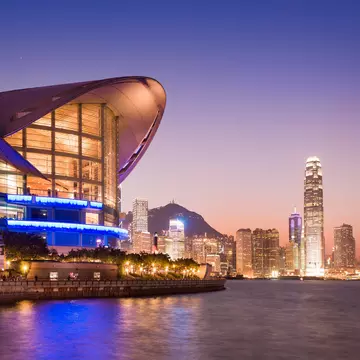
Hong Kong Cultural Centre
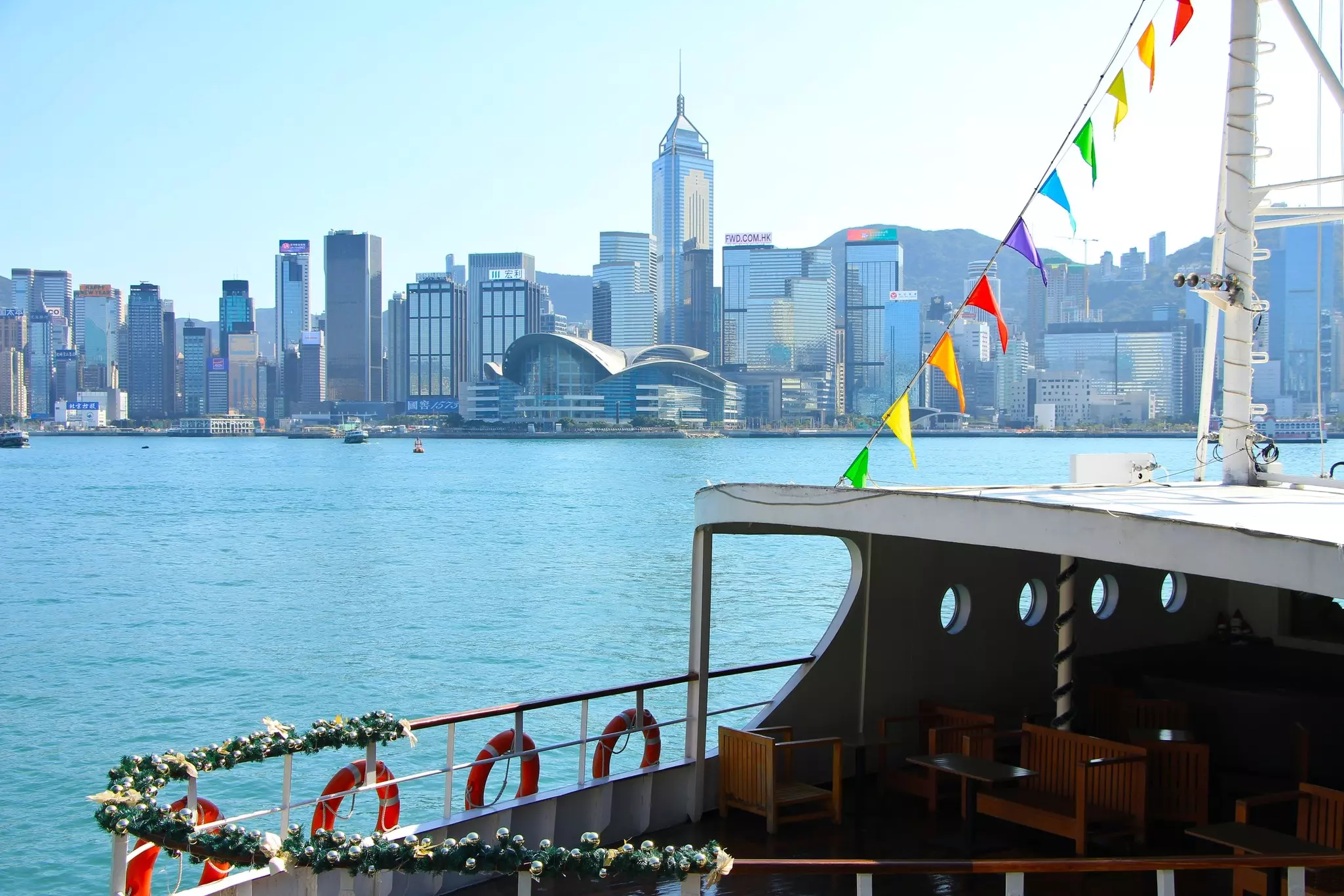
Overlooking the most beautiful part of the harbour, the aesthetically challenged and windowless Cultural Centre is a world-class venue containing a 2085-seat concert hall, a Grand Theatre that seats 1750, a studio theatre for up to 535, rehearsal studios and a decent foyer. On the building’s south side is the beginning of a viewing platform from where you can gain access to the Tsim Sha Tsui East Promenade.
reviewed
-
HSBC Building
Make sure you have a close-up look at the stunning headquarters of what is now HSBC (formerly the Hongkong & Shanghai Bank) headquarters, designed by British architect Sir Norman Foster in 1985. The building is a masterpiece of precision, sophistication and innovation. And so it should be. On completion in 1985 it was the world’s most expensive building (it cost upward of US$1 billion). The building reflects architect Sir Norman’s wish to create areas of public and private space and to break the mould of previous bank architecture. The ground floor is public space, which people can traverse without entering the building; from there, escalators rise to the main banking…
reviewed
-
Yuen Yuen Institute
Stuffed with vivid statuary of Confucian and Buddhist deities, the Yuen Yuen Institute, in the hills northeast of Tsuen Wan, is very much on the tourist trail but is well worth a visit nonetheless. The main building is a (vague) replica of the Temple of Heaven in Beijing. On the upper ground floor are three Taoist immortals seated in a quiet hall; walk down to the lower level to watch as crowds of the faithful pray and burn offerings to the 60 incarnations of Taoist saints lining the walls. This place is packed out at Chinese New Year. There are also deities representing particular years and birth signs, to which worshippers pray and make offerings.
To reach both the…
reviewed
-
E
Discovery Bay
Lying on the northeastern coast of Lantau, what locals have dubbed 'DB' is very much a world of its own (with not a little similarity to the cult '60s TV series The Prisoner). A dormitory community for professionals who commute to Central, Discovery Bay (Yue Ging Wan in Cantonese) has a fine stretch of sandy beach ringed by high-rises and more luxurious condominiums clinging to the headland to the north – but there is no pressing need to visit except to ogle at residents in their converted golf carts, which cost $200,000 a pop.
There is a handful of decent restaurants in Discovery Bay Plaza, just up from the ferry pier and the central plaza, and the 27-hole Discovery…
reviewed
-
Public Viewing Gallery at Bank of China Tower
The Bank of China (BOC) is headquartered in the awesome Bank of China Tower to the southeast of its old home (the Old Bank of China building at 1 Bank St). The tower was designed by Chinese-born American architect IM Pei and completed in 1990. This 70-storey building is Hong Kong’s third-tallest structure after Two International Finance Centre in Central and Central Plaza in Wan Chai. The asymmetry of the building is puzzling at first glance, but it’s really a simple geometric exercise. Rising from the ground like a cube, it is successively reduced, quarter by quarter, until the south-facing side is left to rise upward on its own. Many local Hong Kong Chinese see the…
reviewed
-
F
Bank of China Tower
The Bank of China (BOC) is headquartered in the awesome Bank of China Tower to the southeast of its old home (the Old Bank of China building at 1 Bank St). The tower was designed by Chinese-born American architect IM Pei and completed in 1990. This 70-storey building is Hong Kong’s third-tallest structure after Two International Finance Centre in Central and Central Plaza in Wan Chai. The asymmetry of the building is puzzling at first glance, but it’s really a simple geometric exercise. Rising from the ground like a cube, it is successively reduced, quarter by quarter, until the south-facing side is left to rise upward on its own. Many local Hong Kong Chinese see the…
reviewed
-
G
One & Two International Finance Centre
These tapering, pearl-coloured colossi (respectively 39 and 88 storeys), which some say resemble electric shavers, sit atop the International Finance Centre (IFC) Mall. Both were partly designed by Cesar Pelli, the architect responsible for the World Financial Center in downtown Manhattan. The highest you can get is to theHong Kong Monetary Authority Information Centre, which contains a library and exhibition areas related to Hong Kong’s banking history. There are half-hour guided tours (at 2.30pm Monday to Friday and at 10.30am on Saturday).
reviewed
Advertisement
-
H
Miu Fat Monastery
Miu Fat Monastery in Lam Tei, due north of Tuen Mun town centre, is one of the best kept and most attractive Buddhist complexes in the territory. Guarding the entrance to the main temple are two stone lions and two stone elephants, and there are attractive gardens outside.
On the ground floor there’s a golden likeness of Buddha in a glass case; on the 2nd floor are three larger statues of Lord Gautama. Don’t miss the soaring new extension, a 42m tower with a top storey resembling a huge crystal lotus blossom that glows at night.
This is an active monastery that preserves more of a traditional character than many smaller temples; you’ll see Buddhist nuns in droves…
reviewed
-
I
Trappist Monastery
Northeast of Mui Wo and south of Discovery Bay at Tai Shui Hang is the Roman Catholic Lady of Joy Abbey – better known as the Trappist Monastery. The monastery is known throughout Hong Kong for its cream-rich milk, sold in half-pint bottles everywhere, but, alas, the cows have been moved to the New Territories and Trappist Dairy Milk now comes from over the border in China.
The Trappists, a branch of the Cistercian order, were founded by a converted courtier at La Trappe in France in 1662 and gained a reputation as being one of the most austere religious communities in the Roman Catholic Church. The Lantau congregation was established at Beijing in the 19th century. All…
reviewed
-
J
Pat Sin Leng Nature Trail
This excellent (and easy) 4.4km-long trail, which should take from two to 2½ hours, leads from the Plover Cove Country Park Visitor Centre at Tai Mei Tuk and heads northeast for 4km to Bride’s Pool; there are signboards numbered 1 to 22, so there is little danger of getting lost. The elevation gain is only 300m, the scenery is excellent and the two waterfalls at Bride’s Pool are delightful, but the place gets packed on the weekend. You can either return to Tai Mei Tuk via Bride’s Pool Rd on foot or catch green minibus 20C, which stops at Tai Mei Tuk before carrying on to Tai Po Market MTR station. On Sunday and public holidays only, bus 275R links Bride’s Pool with Tai…
reviewed
-
Good Spring Co
So you’re feeling a bit peaky. Below par. Liverish even. Why not see if a Chinese herbalist can pep you up? Might we suggest the Good Spring Co, directly beneath the Escalator in Central Hong Kong? First for the consultation: you will be asked a few questions, your pulse will be taken and then your tongue examined to reveal how balanced your humours are and whether you have too much heat or cold in your constitution. According to the prognosis the tonic will very likely be a medicinal tea. This may be a simple herbal infusion or something containing more exotic ingredients. Some are helpfully described in the window, such as powdered deer’s horn, monkey’s visceral…
reviewed
-
K
Hong Kong Zoological & Botanical Gardens
Built in the Victorian era, this garden has a pleasant and expansive collection of fountains, sculptures and greenhouses, plus a playground, zoo and some fabulous aviaries. Along with exotic trees, plants and shrubs, some 160 species of bird reside here. The zoo is surprisingly comprehensive, with more than 70 mammals and 40 reptiles, and is also one of the world’s leading centres for the captive breeding of endangered species. Albany Rd divides the gardens, with the plants and aviaries in the area to the east, close to Garden Rd, and most of the animals to the west.
reviewed
-
L
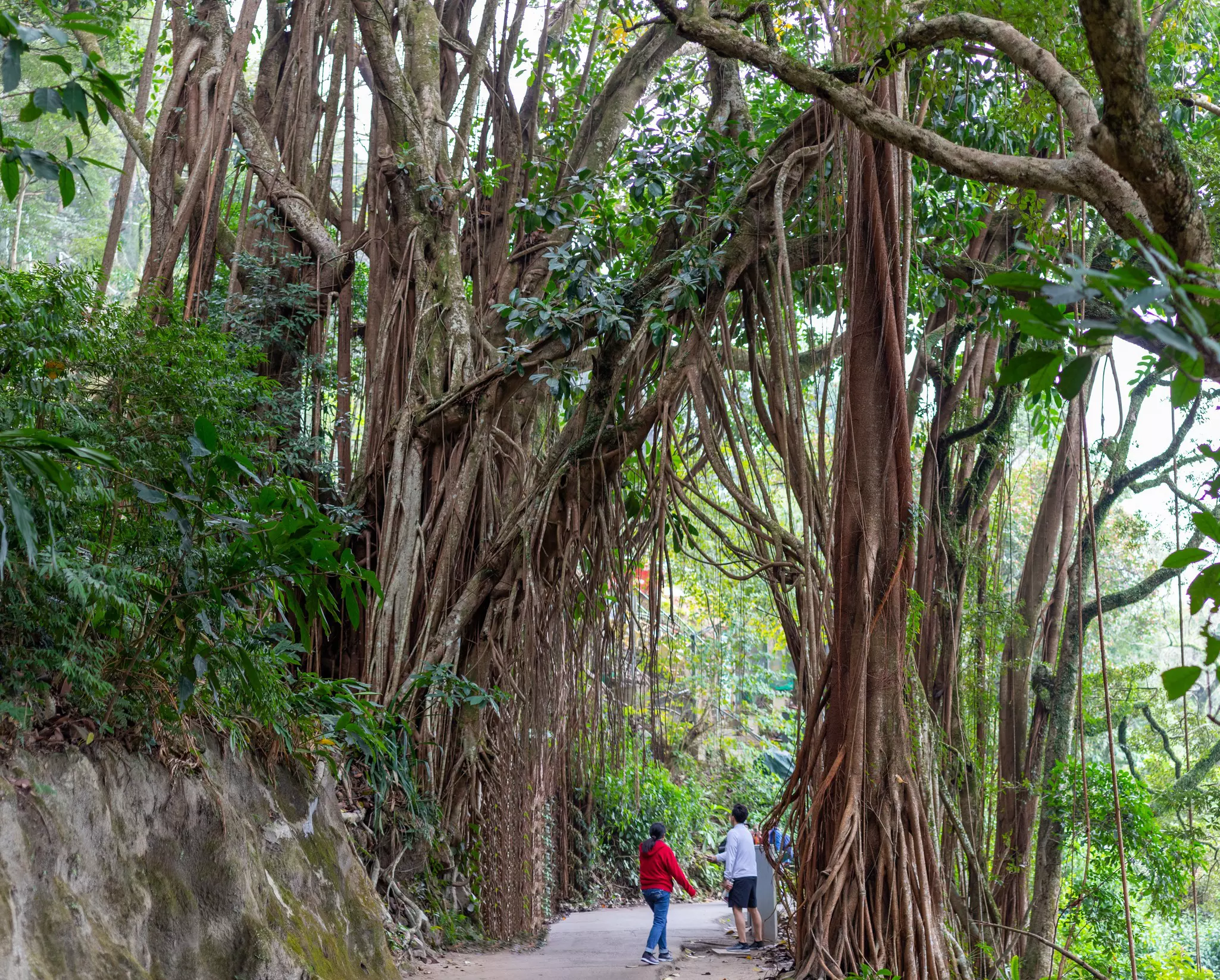
Lam Tsuen Wishing Tree
Until a short time ago Tai Po was the springboard for this large banyan tree, laden with coloured streamers of paper tied to oranges, in the village of Fong Ma Po to the southwest. The idea was to write your wish on a piece of paper, tie it to the citrus fruit and then throw it as high as you could up into the tree. If your fruit lodged in the branches, you were in luck – and the higher it went, the more chance there was of your wish coming true. But things got, er, out of hand just once too often, and in 2005, a week after the end of Chinese New Year, a large branch of the tree came crashing to the ground, dashing most punters’ wishes once and for all.
Focus switched…
reviewed
-
Two IFC
The two tapering, pearl-coloured colossi of One IFC and Two IFC sit atop the International Finance Centre (IFC) Mall and Hong Kong station, terminus of the Airport Express and the Tung Chung lines. Both were partly designed by Cesar Pelli, the man responsible for Canary Wharf in London. One IFC, which opened in 1999, is a ‘mere’ 39 levels tall. At 88 storeys, Two IFC was until recently Hong Kong’s tallest (though not prettiest) building. Given the local penchant for bestowing nicknames on everything, Two IFC has been christened ‘Sir YK Pao’s Erection’, a reference to the owner of the company that built the tower. The claimant to the title of Hong Kong’s tallest…
reviewed
-
M
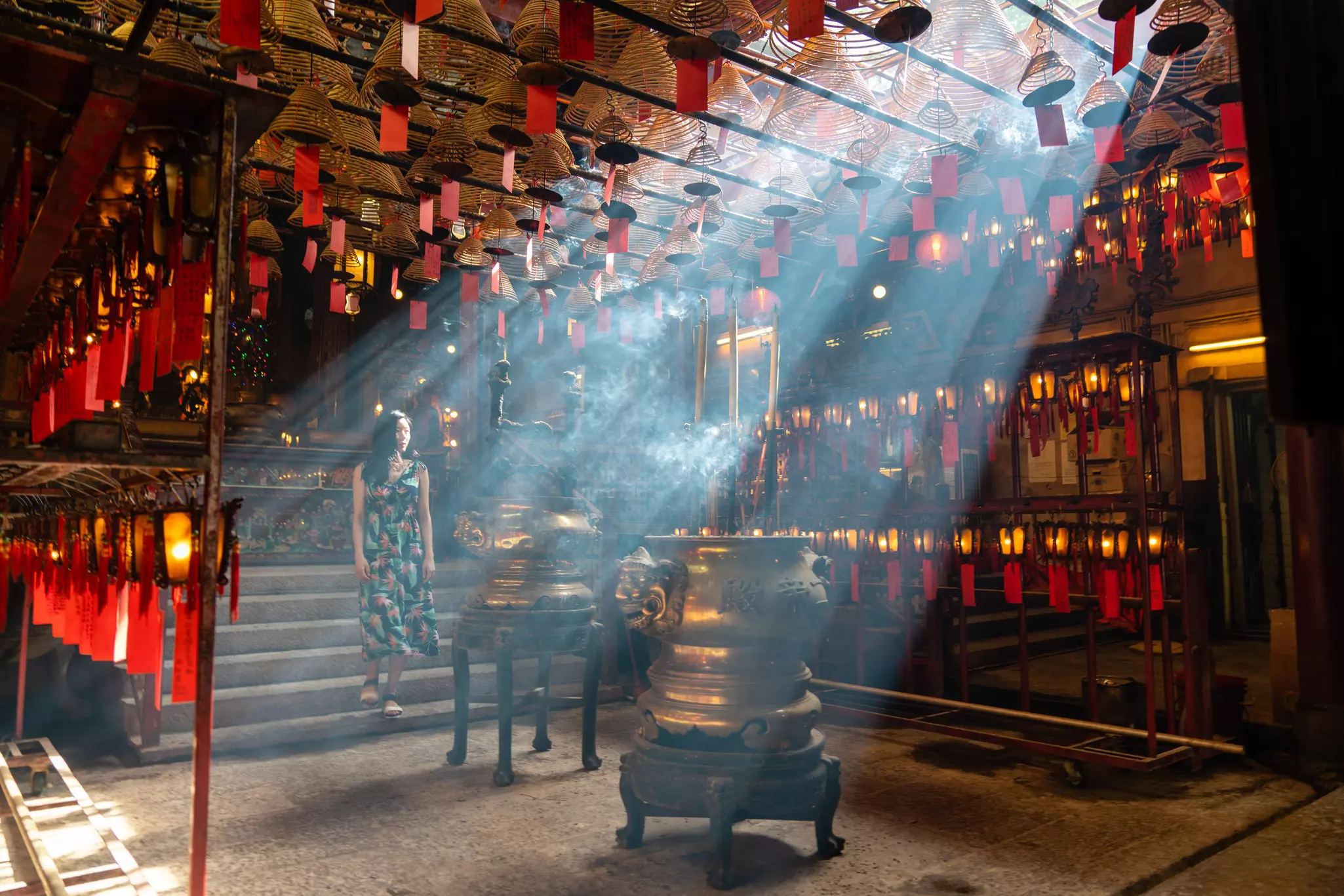
Man Mo Temple
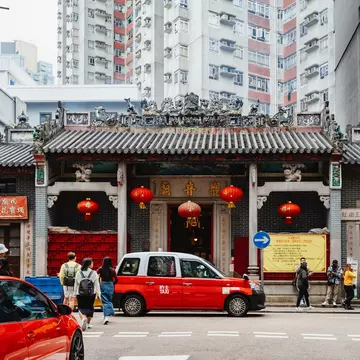
You won’t need a map to find the Man Mo Temple: just follow the smell of incense curling from giant cones suspended from the ceiling of this busy 18th-century temple. One of the oldest and most famous in Hong Kong, Man Mo (literally ‘civil’ and ‘martial’) is dedicated to two deities. The civil deity is a Chinese statesman of the 3rd century BC called Man Cheung, who is worshipped as the god of literature and is represented holding a writing brush. The military deity is Kwan Yu (or Kwan Tai), a Han-dynasty soldier born in the 2nd century AD and now venerated as the red-cheeked god of war; he is holding a sword. Kwan Yu’s popularity in Hong Kong probably has more to do with…
reviewed
-
N
Statue Square
This leisurely square used to house effigies of British royalty. Now it pays tribute to a single sovereign – the founder of HSBC, the banking giant who owns the square. While it lacks statues, there’s plenty to see. In the northern area of the square (reached via a pedestrian underpass) is the Cenotaph (和平紀念碑), built in 1923 as a memorial to Hong Kong residents killed during the two world wars. To the east the Hong Kong Club Building, resembling a swimming stingray, houses a prestigious club of that name that was still not accepting Chinese members until well after WWII. On the south side of Chater Rd, Statue Sq has a pleasant collection of fountains and…
reviewed
-
O
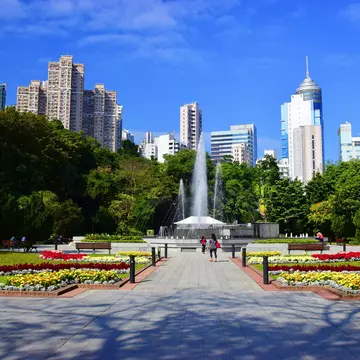
Hong Kong Park
Designed to look anything but natural, Hong Kong Park is one of the most unusual parks in the world, emphasising artificial creations such as its fountain plaza, conservatory, waterfall, indoor games hall, playground, t’ai chi garden, viewing tower, museum and arts centre. For all its artifice, the eight-hectare park is beautiful in its own weird way and, with a wall of skyscrapers on one side and mountains on the other, makes for some dramatic photographs.
The best feature of the park is the delightful Edward Youde Aviary, named after a former Hong Kong governor (1982–86) and China scholar. Home to more than 600 birds representing some 90 different species, it’s nothing…
reviewed
Advertisement
-
P
Shui Tau Tsuen
This 17th-century village, a 15-minute walk north of Kam Tin Rd, is famous for its prow-shaped roofs decorated with dragons and fish along the ridges. Tiny traditional houses huddle inside Shui Tau Tsuen’s walls.
The Tang Kwong U Ancestral Hall and the nearby Tang Ching Lok Ancestral Hall were built in the early 19th century for ancestor worship. The ancestors’ names are listed on the altar in the inner hall and on the long boards down the side. The sculpted fish, on the roof of the entrance hall, symbolise luck; in Cantonese, the word for ‘fish’ (yéw) sounds similar to the word for ‘plenty’ or ‘surplus’. Between these two buildings is the small Hung Shing…
reviewed
-
Q
Mui Wo
Mui Wo (Plum Nest), Lantau's main settlement 'capital', is on Silvermine Bay, which is named for the silver mines that were once worked to the northwest along the Silver River. In fact, many foreign residents refer to Mui Wo as Silvermine Bay.
About a third of Lantau's population lives in the township of Mui Wo and its surrounding hamlets. There are several decent places to stay here and, though the options for eating and drinking are few, they are fine.
Silvermine Bay beach, to the northwest of Mui Wo, has been cleaned up and rebuilt in recent years and is now an attractive place, with scenic views and opportunities for walking in the hills above. There's a complex with…
reviewed
-
R
Tung Chung
Change has come to Tung Chung, on Lantau's northern coast, at a pace that can only happen in Hong Kong. This previously all-but-inaccessible farming region, with the small village of Tung Chung at its centre, has seen Chek Lap Kok, the mountain across Tung Chung Bay, flattened to build Hong Kong's international airport and a New Town rise up, served by the MTR.
As part of the territory's plans to solve its housing crisis, Tung Chung New Town has now become a 760-hectare residential estate. The expected population of Tung Chung and the neighbouring New Town of Tai Ho is 330,000 by 2012.
These developments and transport improvements have put an end to Tung Chung as a peaceful…
reviewed
-
S
Noonday Gun
Built in 1901, this recoil-mounted 3lb cannon is one of the few vestiges of the colonial past in Causeway Bay. The gun stands in a small garden opposite the Excelsior Hotel on Gloucester Rd and is fired at noon every day.
The Noonday Gun is accessible via a tunnel through the basement car park in the World Trade Centre, just west of the Excelsior Hotel. From the taxi rank in front of the hotel, look west for the door marked ‘Car Park Shroff, Marina Club & Noon Gun’.
reviewed
-
T
Hong Kong Heritage Museum
This award-winning, three-storey purpose-built innovator features magnificent displays on Cantonese opera and the cultural heritage of the New Territories, the inspiring Children's Discovery Gallery(which has learning and play zones), the art collection of one Dr TT Tsui and, from time to time, the wonderful works of Hong Kong's little-known but excellent photographers.
reviewed