go to content go to search box go to global site navigation

Québec

Sights in Québec

  1. A

    Christ Church Cathedral

    Montréal’s first Anglican bishop had this cathedral built (modeled on a Salisbury, England, church) and it was completed in 1859. The church was the talk of the town in the late 1980s when it allowed a shopping center, the Promenades de la Cathédrale, to be built underneath it. Spectacular photos show the house of worship resting on concrete stilts while construction went on underneath. The interior is sober apart from the pretty stained-glass windows made by William Morris’ studios in London. In the rear cloister garden stands a memorial statue to Raoul Wallenberg, the Swedish diplomat who saved 100,000 Jews from the concentration camps in WWII.

    reviewed

  2. B

    Discovery Pavilion

    the main gateway to Battlefields Park, the Discovery Pavilion houses a museum as well as the excellent Québec City tourist office, Centre Infotouriste. The main draw here is the permanent exhibition entitled Odyssey. In it, you move from theater to theater where the history of the Plains of Abraham are depicted through clever multimedia presentations and generous doses of good humor. There’s a fine exhibit at the end devoted to French and British colonial military with displays depicting the lives of soldiers in the New World. The exhibit on their uniforms, which describes the significance of the designs and colors, is nicely done.

    reviewed

  3. C

    Nunavik Information Centre

    Far in Québec’s north, Nunavik (not to be confused with Canada’s third territory, Nunavut) is almost completely inhabited by Inuit. With no trains or roads into Nunavik, even most Quebecers know little about the Inuit culture or this fascinating region. This modest center was opened mainly to promote tourism to the area’s 14 villages, but it’s an interesting place for a short stop just to look at the wall pictures or the small craft displays. It’s an incredibly friendly place and the employees are more than willing to shoot the breeze for the genuinely curious, answering questions on anything from the Inuit language to Inuit culture.

    reviewed

  4. D

    Église St-Roch

    There are giants and then there is this, the biggest church in Québec City. Measuring over 80m long, 34m wide and 46m high including the steeples, it was built between 1914 and 1923. When the original architects died, the neo-Gothic, neo-Roman structure was finished off by Louis-Napoléon Audet, the same man who worked on the Ste-Anne-de-Beaupré Basilica. The marble inside the church is from Saskatchewan. See if you can find faint fossil imprints in it. Around late October the St-Roch Church hosts the Festival des Musiques Sacrées de Québec (the Québec City Festival of Sacred Music), a wonderful time to see it at its best.

    reviewed

  5. E

    Cathédrale Marie-Reine-du-Monde

    The Cathedral of Mary Queen of the World is a smaller but still magnificent version of St Peter’s Basilica in Rome. The architects scaled it down to one-quarter size, mindful of the structural risks of Montréal’s severe winters. This landmark was built from 1870 to 1894 as a symbol of Catholic power in the heart of Protestant Montréal. The 13 statues of saints over the entrance are sculpted in wood and covered with copper; at nighttime they’re brilliantly illuminated. The neobaroque altar canopy, a replica of Bernini’s masterpiece in St Peter’s, is fashioned of gold leaf and copper with swirled roof supports.

    reviewed

  6. Abbaye St-Benoît-du-Lac

    Lac Memphrémagog is the largest and best-known lake in the Eastern Townships, but most lakefront properties are privately owned. Halfway down the lake is the Abbaye St-Benoît-du-Lac. The monks’ chants, cider and wide range of finely made cheeses are famous throughout Québec and people from all over the province descend on the abbey’s shop to buy them along with the monks’ jams, sweets, jellies and chocolate-covered blueberries. Visitors can also attend services (and join the monks in prayer and Gregorian chanting at 7:30am, 11am and 5pm), and there’s a hostel for men and another for women nearby at a nunnery.

    reviewed

  7. F

    Fonderie Darling

    Tucked away in a little-visited corner of Old Montréal, the Darling Foundry hosts avant-garde, often large-scale exhibitions in its two sizable showrooms. The brick industrial building, which dates back to the early 1900s, once housed a prosperous iron foundry and is today home to the gallery and live-work studios for artists. The space also houses the Cluny Artbar (entrance around the corner on Rue Prince), a fine spot for coffee, desserts or light lunch fare. In the summertime, the foundry hosts occasional Thursday-night street parties (when admission is free). Check the website for upcoming exhibitions.

    reviewed

  8. G

    Three Courthouses

    Along the north side of Rue Notre-Dame Est near Pl Jacques-Cartier, three courthouses stand bunched together. The most fetching is the neoclassical Vieux Palais de Justice, Montréal’s old justice palace and oldest courthouse (1856) that’s now an annex of the Hôtel de Ville. It’s a popular backdrop for wedding photos. The Édifice Ernest Cormier from the 1920s was used for criminal trials before being turned into a conservatory and later a court of appeal. The ugly stepsister is the oversized Palais de Justice, built in 1971 when concrete and smoked glass were all the rage.

    reviewed

  9. H

    Bank of Montréal

    Modeled after the Pantheon in Rome, the grand colonnaded edifice of Canada’s oldest chartered bank, built in 1847, dominates the north side of Place-d’Armes and is still a working bank. The imposing interior has 32 marble columns and a coffered 20m ceiling in Italian Renaissance style over a long row of tellers behind glass partitions. The helmeted marble lady is Patria, representing a minor Roman god of patriotism to honor the war dead. A snoozy money museum inside the bank has a replica of a cashier’s window, old banknotes and an account of early banking in Canada.

    reviewed

  10. I

    Cimetière Notre-Dame-des-Neiges

    More than one million people have found their final resting place here since this Catholic cemetery opened in 1854, making it the largest cemetery in Canada. It has a few intriguing mausoleums that emit solemn music, including that of Marguerite Bourgeoys, a nun and teacher who was beatified in 1982. The catalog of permanent guests includes 20 Montréal mayors, several ex-passengers of the Titanic, and Calixa Lavallée, the composer of ‘O Canada.’ The cemetery office has brochures for self-guided tours around the tombs but there’s also a map posted at the entrance.

    reviewed

  11. Advertisement

  12. J

    Bibliothèque et Archives Nationale du Québec

    This stunning building houses both the library and national archives of Québec and has been a success beyond planners wildest dreams. Originally conceived as a place to receive between 5000 to 6000 people per day, the reality has been 10,000 to 12,000 Montrealers flocking through its doors each day. The library itself is 33,000 sq meters, connected to the métro and underground city.

    Since 1968, everything published in Québec (books, brochures, sound recordings, posters) has been deposited here. It also buys historical documents as well as anything published about Québec outside the province or internationally.

    reviewed

  13. K

    St Patrick’s Basilica

    Built for Montréal’s booming Irish population in 1847, the interior of St Patrick’s Basilica contains huge columns from single pine trunks, an ornate baptismal font and nectar-colored stained-glass windows. The pope raised its status to basilica in 1989, in recognition of its importance to English-speaking Catholics in Montréal. It’s a sterling example of French-Gothic style and, as you might expect, is classified a national monument. The Irish-Canadian patriot D’Arcy McGee was buried here after his assassination in 1868; his pew (number 240) is marked with a small Canadian flag.

    reviewed

  14. L

    Église Notre-Dame-des-Victoires

    Dating from 1688, Our Lady of Victories Church, a modest house of worship on the square, is the oldest stone church in the USA and Canada. It stands on the spot where Champlain set up his ‘Habitation, ’ a small stockade, 80 years prior to the church’s arrival. Inside are copies of works by Rubens and Van Dyck. Hanging from the ceiling is a replica of a wooden ship, the Brézé, thought to be a good-luck charm for ocean crossings and battles with the Iroquois. The church earned its name after British ships were unable to take Québec City in 1690 and again in 1711.

    reviewed

  15. Aquarium du Québec

    Spread across 40 hectares, Québec’s aquarium contains some 10,000 aquatic creatures, in the form of freshwater and saltwater fish, amphibians, reptiles, invertebrates and marine mammals. The park is divided into several habitats, including a wetlands region and an arctic sector (with an underwater observation window of the polar bears). There’s also a food court with a terrace overlooking the river. You can catch daily events like walrus feeding (10:30am) and polar bear feeding (11am) or live shows with either a walrus (3:30pm) or a trained harbor seal (1:15pm and 4:15pm).

    reviewed

  16. M

    Belvédère Camillien-Houde

    This is the most popular lookout on Mont-Royal thanks to its accessibility and large parking lot. Naturally enough, it’s a magnet for couples once night falls, making it nearly impossible on summer nights to find a parking space. You can walk to Chalet du Mont-Royal about half an hour away. To get to this lookout, take the stairs that lead from the parking lot. There’s also a quick alternative: after the first set of stairs turn left and walk a few meters to an unofficial lookout point. The protruding boulder gives a fantastic panorama free of guard rails.

    reviewed

  17. N

    Musée Redpath

    A Victorian spirit of discovery pervades this old natural history museum, though you won’t find anything more gruesome than stuffed animals from the Laurentians hinterland. The Redpath Museum houses a large variety of specimens, including a dinosaur skeleton and seashells donated from around the world. A highlight is the 3rd-floor Ethnology Gallery, which traces the beginnings of human civilization. It includes Egyptian mummies, shrunken heads and artifacts from ancient Mediterranean, African and East Asian communities. In winter it’s also open Friday.

    reviewed

  18. O

    Windsor Hotel

    The palatial Windsor was Canada’s first grand hotel (1878) and played host to all manner of international guests and celebrities, including Mark Twain, Winston Churchill, King George VI, Queen Elizabeth II and John F Kennedy. The original Windsor had six restaurants and 382 sumptuous guest rooms, but a fire that devastated the hotel in 1957 left only the annex – the portion still standing today. You can stroll down the magnificent main hall, Peacock Alley, and peek at the vast wooden dance floors, chandeliers and high windows that recall turn-of-the-century splendor.

    reviewed

  19. P

    Place du Canada

    This park immediately southeast of Sq Dorchester is best known for its monument of John A Macdonald, Canada’s first prime minister, who addressed the maiden session of parliament in Montréal. The two cannons around the base were captured in the Crimean War; if you look closely you’ll see the dual-headed eagle of Czar Nicholas I. The statue was decapitated by vandals in 1992 and the head vanished for two years. The overpass across Blvd René-Lévesque leads to the Marriott Château Champlain Hotel, known as the ‘cheese grater’ for its windows shaped like half-moons.

    reviewed

  20. Q

    Musée Juste Pour Rire

    The Just for Laughs Museum is the seat of the summer comedy festival of the same name. Apparently comedian George Burns was nearly killed by a brick of fake banknotes here, but otherwise guffaws are few and far between. A favorite with kids, the Abracadabra show reveals a fascinating glimpse of magic and magicians behind the scenes. The adjacent Cabaret Theater (845-2014) stages special events and shows.

    This warehouse space runs the best 100 comedy clips from comics around the world, from Roberto Benigni to Steve Martin, in its International Humor Hall of Fame.

    reviewed

  21. R

    Illuminated Crowd

    The Illuminated Crowd is one of Montréal’s most talked-about sculptures and arguably its most photographed piece of public art. The inscription reads in part: ‘A crowd has gathered…the strong light casts shadows, and as light moves toward the back and diminishes, the mood degenerates; hooliganism, disorder and violence occur.’ The group placed on four giant steps ranges from wide-eyed, upstanding citizens in the front to miscreants in the rear as the steps descend downwards. They’re made of polyester resin with a vanilla-yellow coating.

    reviewed

  22. Advertisement

  23. S

    Lieu Historique de Sir George-Étienne-Cartier

    The Sir George-Étienne Cartier National Historic Site consists of two historic houses owned by the Cartier family. Exhibitions in the first detail the life of Sir George-Étienne Cartier, one of the founders of the Canadian Confederation, and illustrate the changes that society saw in his lifetime. The other house is a faithful reconstruction of his home during the Victorian era. Staff in period costume run guided tours throughout the day and hold dramatic presentations on etiquette and a servant’s life. In season the program includes a Victorian Christmas.

    reviewed

  24. Parc National du Mont-Tremblant

    Opened more than a century ago, the wild, wooded Parc National du Mont-Tremblant covers more than 1500 sq km of gorgeous Laurentian lakes, rivers, hills and woods. You’ll find fantastic hiking and mountain-biking trails as well as camping and river routes for canoes. The half-day route from Lac Chat to Mont de la Vache Noire ($19) is particularly popular. If you are planning for activities, be sure to reserve a canoe and a place on the shuttle bus by calling the Information Center Parc du Mont-Tremblant well in advance of your arrival.

    reviewed

  25. T

    Biosphère

    Located in the striking spherical dome of the former American pavilion in the ‘67 World’s Fair, the center has the most spectacular collection of hands-on displays in the entire city. Exhibits focus on the world of water, the St Lawrence River ecosystem (which, together with the Great Lakes, makes up 25% of the planet’s freshwater reserves) and emerging ecotechnologies. Hands-on exhibits all involve real water, and though primarily geared to kids, big people will also find it worthwhile. The upstairs Visions Hall offers a great view of the river.

    reviewed

  26. U

    St Lawrence Seaway

    This system of locks, canals and dams that opened in 1959 along the St Lawrence River enables oceangoing vessels to sail 3200km inland via the Great Lakes. Across Pont Victoria from the city is an observation tower over the first locks of the system, the St Lambert Locks, where ships are raised/lowered 5m. From January to March, the locks are closed – they’re frozen like the river itself until the spring thaw. The site can be reached by the bike trail on the south shore of the St Lawrence, about 300m southwest of Pont Jacques-Cartier.

    reviewed

  27. V

    Gare Windsor

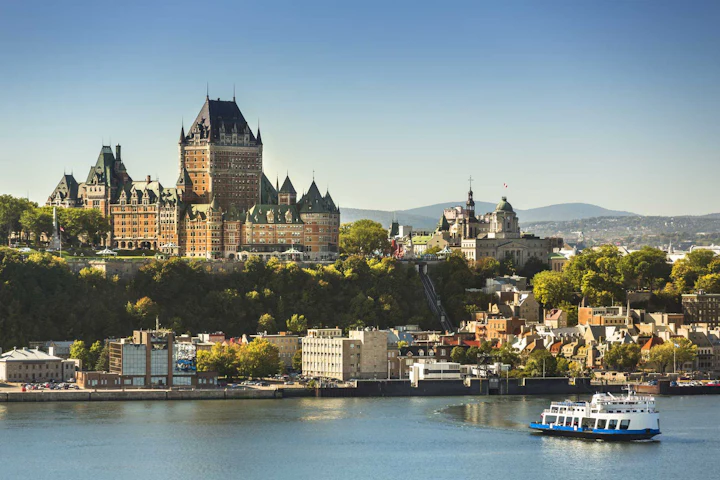
    The massive Victorian building hugging the slope west of the Marriott Château Champlain is the old Windsor Station, opened in 1889 as the headquarters of the Canadian Pacific Railway. The Romanesque structure inspired a château style for train stations across the country; its architect, Bruce Price, would later build the remarkable Château Frontenac in Québec City. The station is no longer the terminus of the trans­continental railway but still serves commuter trains. Much of the building today houses offices and shops.

    reviewed