go to content go to search box go to global site navigation

Belgium

Things to do in Belgium

  1. A

    Groeningemuseum

    Bruges' prized collection of art dating from the 14th to the 20th century is housed in the small Groeningemuseum. Highlights of this prized collection of art dating from the 14th to the 20th century are the Flemish Primitives (Room 2), including masterpieces by Jan Van Eyck and Hans Memling. But also look out for works by Hieronymus Bosch (Room 1), and surrealists René Magritte and Paul Delvaux (Room 9).

    Room 1, entitled Municipal Patronage, concentrates on works from the 15th and 16th centuries, many of which were commissioned by the city of Bruges. The gruesome Judgement of Cambyses (1498) by Gerard David depicts the Persian king being led from his throne and flayed…

    reviewed

  2. B

    Grand Place Guildhalls

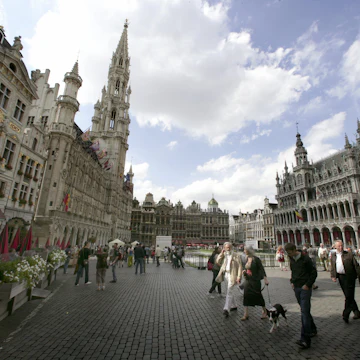
    The splendour of the Grand Place is due largely to the antique frame of Grand Place guildhalls. Each merchant guild erected its own building, which is named (no street numbers back then) and adorned with gilded statues and elaborate symbols related to its trade. When the guildhalls were obliterated in the 1695 bombardment, the guilds rallied and rebuilt their headquarters using stone (rather than partial timber as before) for the façades and adding fanciful baroque touches to the gables.

    Some of the highlights:

    Maison du Roi (King's House- Opposite the Hôtel de Ville, this dark, brooding building was never home to royalty, despite the name. These days it houses the Musée…

    reviewed

  3. C

    Onze Lieve Vrouwekathedraal

    The splendid Onze Lieve Vrouwekathedraal is the largest and finest Gothic cathedral in Belgium. It was 169 years in the making (1352-521) and the work of several architects (Appelmans, Domien and Keldermans). Its graceful 123m-high spire was a mighty landmark in early times and is still visible from kilometres around today.

    The combined effects of a fire in the Middle Ages, the Iconoclastic Fury and plundering during the French occupation mean that little of what you see today inside the cathedral is original Gothic. Instead, baroque decorations - notably four early canvases by Rubens - adorn its light but imposing interior.

    From the centre of the seven-aisled nave, look…

    reviewed

  4. D

    Heilig-Bloedbasiliek

    The Heilig-Bloedbasiliek takes its name from the relic of Christ's blood brought here after the Crusades, sometime between 1150 and 1200. The church has two distinct and highly contrasting sections: the sombre 12th-century lower chapel, built along pure Romanesque lines and almost devoid of decoration, and the much-renovated and lavishly embellished upper chapel, accessed by wide stairs near the lower chapel's entrance.

    In the upper chapel is the silver tabernacle containing the phial that holds a few drops of the holy blood. This relic is still venerated in one-hour services at 10:00 and 15:00 every Friday. On Ascension Day it is paraded through the city in Bruges'…

    reviewed

  5. E

    Terra Nova

    What remains of Namur's once-mighty Citadelle De Namur is slung high above the town on a rocky outcrop. Due to centuries of military expansion, it covers a huge area, though only towers, tunnels and much of the outer walls exist today. Visitors are free to wander around, and access is possible by car, bike, foot or minibus. The latter depart regularly from the tourist office and stop at Terra Nova.

    To reach the citadel on foot, head up from the path on Pl St Hilaire; by car or bike follow the Rte Merveilleuse.

    The best place to start is the new information point, Terra Nova. Oddly, it's not signposted as such - instead, look out for the sign 'Domaine fortifié'. Attractions…

    reviewed

  6. F

    Kantcentrum

    Watch lace-makers at work at the Kantcentrum. Lace (kant in Flemish, dentelle in French) blossomed in Flanders in the 16th century. Naaldkant (needlepoint lace), which developed in Italy, was predominantly made in Brussels while kloskant (bobbin lace) is believed to have originated in Bruges. The latter requires thousands of painstaking and meticulous movements of bobbins and pins. Each lace-maker had her own patterns, which stayed in the family and were handed down through generations.

    The Kantcentrum is best known for its bobbin lace-making demonstrations - informal gatherings of 20 or so women who congregate (afternoons only) in a small room at the rear of the complex.…

    reviewed

  7. G

    Musées Royaux des Beaux-Arts de Belgique

    This museum houses Belgium's premier collections of ancient and modern art and is particularly well endowed with works by Pieter Breugel the Elder, Rubens and the Belgian surrealists. Both sections are large and you'll need a good day here if you want to do them justice.

    Highlights of the Museum of Ancient Art are paintings from the 15th and 16th centuries, including Flemish primitives, Hans Memling, Rogier Van der Weydan, Dirk Bouts, and a whole room dedicated to Hieronymus Bosch.

    Rubens dominates the 17th- and 18th-century collection, including the magnificent Adoration of the Magi, although you'll also get to appreciate fantastic pieces by Brueghel the Elder and…

    reviewed

  8. H

    Museum Plantin-Moretus

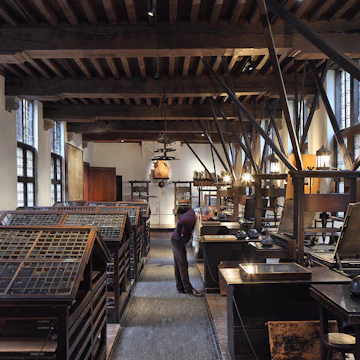
    The World Heritage-listed Museum Plantin-Moretus is home to the world's first industrial printing works. This fascinating museum deals with a prosperous 16th- and 17th-century printing family headed by Christoffel Plantin. Plantin moved from France to Antwerp where he set up as a bookbinder in 1548. Eight years later he started a printing business that eventually became the Low Countries' largest printing and publishing concern and a magnet for intellectuals, scientists and humanists.

    On Plantin's death, the business passed to his son-in-law, Jan Moretus, and later to Jan's son, Balthasar, a friend of Rubens.

    Some of the family portraits exhibited inside this museum are…

    reviewed

  9. I

    Trésor du Prieuré d'Oignies

    Don't miss the Trésor du Prieuré d'Oignies. This one-room treasury is housed in a modern convent and is guarded by the Sisters of Our Lady. Ring the bell to be taken on a guided tour of the exquisite hoard of Gothic religious treasure (chalices, crosses and reliquaries), much of which was created by Brother Hugo d'Oignies. Like other famous artworks in Belgium, this collection has a colourful history.

    During the French Revolution, when art treasures were being carted off to Paris, the monks in charge of the priory where Brother Hugo had lived took the artworks to a local farmer who walled them up in his house. When the last monk died in 1818, the treasure was given to…

    reviewed

  10. J

    Rubenshuis

    Rubenshuis, the prestigious home and studio of the city's most celebrated painter, Pieter Paul Rubens, it was little more than a ruin when acquired by the city in 1937. Superbly restored along original lines, it's now Antwerp's chief attraction, despite the fact that only a handful of Rubens' lesser works are exhibited here. Rubens built this beautiful Flemish baroque mansion in 1611 when he was 34 years old; he died here 29 years later.

    The building is divided in two: on the left are the living quarters and an elaborate art gallery where Rubens displayed sculptures and paintings by artists he admired; to the right you'll see the master's studio where he taught and…

    reviewed

  11. Advertisement

  12. Ghent and Bruges Day Trip from Brussels

    Ghent and Bruges Day Trip from Brussels

    9.5 hours (Departs Brussels, Belgium)

    by Viator

    Discover two of Flanders' special gems on a full day trip to Ghent and Bruges. No visit to Belgium is complete without a visit to these two beautiful cities,…

    Not LP reviewed

    from USD$55.88
  13. K

    Markt

    Bruges' nerve centre is the historic Markt, a large open square flanked by medieval-style buildings and bustling with horse-drawn carriages, open-air restaurants and camera-clicking tourists. Standing tall at its centre is a monument to Pieter De Coninck and Jan Breydel, the leaders of the Brugse Metten, and lording over everything is the fabulous belfry.

    Most of the gabled guildhalls edging the Markt are not original. Notable at Markt 16 is Craenenburg café; in this building the Hapsburg heir Maximilian of Austria was imprisoned by the leaders of the city in 1488 after attempting to restrict their privileges. When Maximilian later became emperor, he took revenge by…

    reviewed

  14. L

    Fietsen Popelier

    A recommended bike rental outfit. Children's bikes (same prices as adults') are available, and baby/toddler seats and baskets are provided for free. Helmets can also be hired. No deposits are required for bikes. The cycles here are in excellent condition - never more than six months old, with moulded seats, six gears and good suspension. Some regional cycling maps, including the Riante Polder Route, are sold.

    Stay around town - there's no better way to see a sizable swath of the city in a relatively short time - or head out along the Damse Vaart canal to Damme (30 minutes, 6km one way). Alternatively, the Riante Polder Route is a full-day excursion, clocking up 44km and…

    reviewed

  15. M

    Gin Fish

    Didier Garnich knew it was risky closing his seafood restaurant De Matelote and relinquishing its Michelin star. But he longed for the pre-Michelin days, when an open kitchen allowed him to laugh with the people whose meals he was preparing, and there was no mandate to slavishly follow classic formulas. So he took the gamble and opened Gin Fish. Same address, same attention to quality, same devotion to fish… only this time he's doing it his way.

    There's no exhaustive seafood menu, as out-of-season fish is not an option. Instead, only the freshest catch is cooked, and only one menu-of-the-day is offered: two entrées, a main and dessert. Each evening has three sittings -…

    reviewed

  16. N

    Bruparck

    The theme park, Bruparck, incorporates a water fun park, Océade, the giant Kinepolis cinema with a multiplex and an IMAX, and the highlight, Mini-Europe. In the latter, over 350 miniature scale models (all 1:25) depict some of Europe’s best-known architectural highlights, such as the cathedral of Santiago de Compostela (which took 24,000 man-hours to create), London’s Big Ben, Lisbon’s Torre de Belem and Paris’ Pompidou Centre; with various moving features like little railways, and even a cross-section of the Chunnel. It’s a fun way for kids (and kids-at-heart) to brush up on European geography, and the models are true works of art. On some weekend nights in summer…

    reviewed

  17. O

    Cogels-Osylei

    This area, about 2km southeast of Centraal Station, is famed for the eclectic architecture found in a handful of streets. The showcase is Cogels-Osylei, a bazaar of all possible house styles. Here the city's affluent citizens went wild a century ago, creating competing and highly contrasting façades ranging in style from Art Nouveau and Flemish baroque to neoclassical and neo-Renaissance. Roofs and towers spiked with onion tops or witches' hats, wrought-iron balconies, bay windows, slate tiles, stained glass and mosaics…you name it, this street's got it.

    Most of the buildings were constructed between 1894 and 1914 and involved many architects. In the 1960s the houses…

    reviewed

  18. P

    René

    Deep in the heart of Anderlecht, overlooking a tree-lined square and the local gemeentehuis (town hall), is Brussels' most authentic family friterie-restaurant. It's the Dirk and Dorine Piolon show. Dad, Mum, offspring and in-laws, frying and refrying the frites, preparing a succulent filet américain and dishing up steaming cauldrons of mussels and other Belgian specialities to an appreciative local audience.

    Turn up here at lunchtime on Saturday, as the market vendors on the facing square pack up their wares, and you'll find it's full house - only the rickety green metal tables decorating the footpath are unoccupied. For that quintessential Belgian experience, and not a…

    reviewed

  19. Q

    Stadhuis

    Leuven's main sight is the 15th-century Stadhuis. This flamboyant late-Gothic structure resembles an overblown wedding cake full of terraced turrets, delicate statues, fancy stonework and colourful flags. The 236 statues represent prominent locals throughout the ages - scholars, artists and nobility - but were added as an afterthought in the mid-19th century.

    Incredibly, the stadhuis survived relatively unscathed during the wars (although a bomb, which failed to explode, scoured part of the façade). There's not all that much to see inside; most notable are the few sculptures by Constantin Meunier. More of Meunier's work is located in Minderbroedersvest, where he had a…

    reviewed

  20. R

    Rockoxhuis

    The Rockoxhuis is a 17th-century mansion that once belonged to Nicolaas Rockox, a former city mayor and friend and patron of Rubens. It's built around a central courtyard, is furnished in classical Flemish style, and holds a small but esteemed collection of paintings, including works by Rubens, Jordaens, Van Dyck and Pieter Breughel the Younger.

    Seek out the latter's Proverbs (De Spreekwoorden in Flemish). This engaging work is no run-of-the-mill village scene - it depicts 108 Flemish proverbs. Find the man bashing his head against a brick wall (ie symbolising stupidity) or the guy peeing on the moon (ie trying to do the impossible). The museum sells a card explaining…

    reviewed

  21. S

    Taverne du Passage

    Consistently keen service and faithful Belgian meals are the pivotal points of this Brussels institution. Located in the sublime Galeries St Hubert, it has been around since 1928 and stepping through the draped doorway is like zapping away a century. An all-male middle-aged crew strut their stuff in slightly crumpled penguin uniforms, serving ample portions of Belgian classics such as moules-frites (mussels and chips) and waterzooi (cream-based chicken or fish stew).

    With some daring, this could be the place to try filet américain (raw minced beef). No matter how busy it gets, the blokes are unfailingly friendly. In summer, tables line up in the gallery outside, and…

    reviewed

  22. Advertisement

  23. T

    Museum St Janshospitaal

    The prestigious Museum St Janshospitaal is housed in a restored chapel of a 12th-century hospital. It's home to six masterpieces by Hans Memling, plus many works by lesser-known painters of that time. Memling is noted for the fine quality of the figures in his religious paintings, such as the central panel of the Mystic Marriage of St Catherine triptych (1479) that's presented here.

    Perhaps more enchanting is the reliquary of St Ursula. Shaped like a miniature wooden Gothic church, the reliquary's six painted panels depict the medieval tale of the beautiful St Ursula and the 11,000 virgins who were massacred by the Huns in Germany while returning from a pilgrimage to…

    reviewed

  24. U

    Museum Mayer Van den Bergh

    Museum Mayer Van den Bergh occupies a simulated 16th-century townhouse, built in 1904 by the mother of Fritz Mayer Van den Bergh, a prosperous art connoisseur who had died a few years earlier aged 41. His highly prized collection of sculptures and paintings, including works by Quinten Matsijs and Cornelius De Vos, form the core of the museum.

    The collection's most famous piece is Pieter Breugel the Elder's Dulle Griet (Mad Meg), an allegorical painting in which a demented woman roams a grotesque war-torn landscape marked by demons and monsters. This is one of Breugel's most Bosch-like paintings and interpretations of its meaning vary - some say it's an allegory of…

    reviewed

  25. V

    Treasury of St Peter's

    The St Pieterskerk Treasury boasts two triptychs by Flemish Primitive artist Dirk Bouts (1415-75), who spent much of his life in Leuven. Bouts painted the triptychs between 1464-67, one of which, Het Laatste Avondmaal (The Last Supper), is considered to be one of the period's masterpieces. It mixes the Biblical theme with contemporary Gothic architecture.

    Strictly controlled paintings with rich, broad landscapes and static, unmoving figures were Bouts' passion. The panels have a lively history: they were sold off several times and ended up in Germany; returned to Leuven after WWI as part of the war reparations package, they were carted off again during WWII and saw the…

    reviewed

  26. Diamond District

    Immediately southwest of Centraal Station is the Diamond District. The first things most people see of this quarter are the gold and diamond shops newly located inside Centraal Station. Here you'll find people from all over the world, including plenty of newly engaged Brits (prices here average 30% lower than in UK High Sts) browsing the bright lights and gleaming displays.

    But outside, it's a vastly different world. Orthodox Jewish men clad in distinctive black coats and hats shuffle around the lacklustre quarter, traders with briefcases handcuffed to their wrists hurry into diamond exchanges and armed guards keep watch over the little huddle of streets where…

    reviewed

  27. W

    Nationaal Scheepvaartmuseum Steen

    This engaging museum houses model ships, maritime maps and instruments in the gatehouse and front section (which is all that remains) of the 13th-century castle, Steen. Highlights include an intriguing nautical totem shaped like a snake's head and boats from around the world, including an 18th-century coracle or skin boat. Beneath the next-door raised promenade is the museum's open-air collection of river barges, canal boats and De Schelde P905, a 1950's Belgian navy patrol ship.

    It's on the foreshore of the River Scheldt to the immediate west of the old centre, within the partly-restored confines of a castle called the Steen that dates from 1200 and is Antwerp's oldest…

    reviewed